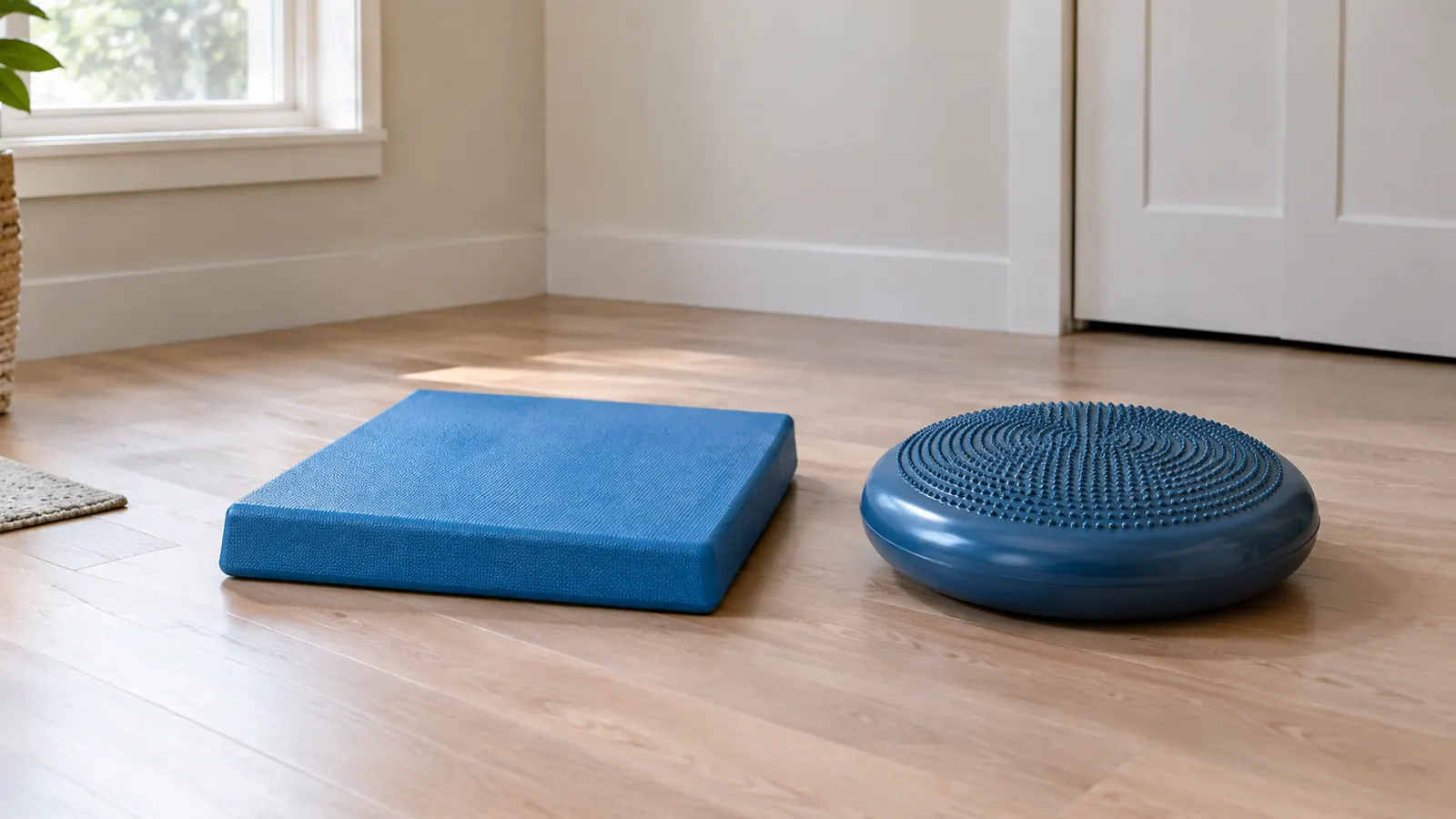
I bought the ProsourceFit balance pad in March and an inflatable wobble cushion about three weeks later, because I could not get a straight answer anywhere about which one a person my age should actually start on. Every article I found treated them as the same product with two names. They are not. They ask your body for different things, they fail in different ways, and after six months of alternating days in my spare bedroom I have a clear opinion about which one belongs on the floor first.
I am 62. I walk three to four miles most mornings on the river trail, and I take a swing dance class on Thursday evenings, which is the real reason any of this matters to me. Dancing on a wood floor with other people moving around you asks a lot more of your ankles than walking in a straight line does. My left knee complains on stairs and after long drives. So I came into this wanting steadier footing, not a workout.
The short version
The foam pad is the better place to start and the better place to stay for most people reading this. It gives you an unstable surface that stays put, which sounds like a contradiction until you stand on both. The wobble cushion is genuinely harder, genuinely useful, and much easier to quit. If you buy one, buy the pad. If you buy both, buy them in that order and give the pad two months by itself first.
| Spec | ProsourceFit Balance Pad | Inflatable Wobble Cushion |
|---|---|---|
| Shape and footprint | Rectangular, roughly 15 by 13 inches, both feet fit side by side | Round, about 13 inches across, one foot at a time for most work |
| Thickness | About 2.5 inches of dense foam | Around 2 inches inflated, changes with air pressure |
| How it moves | Compresses and sinks, resists in every direction evenly | Rolls and tips, the air shifts under you |
| Difficulty to start | Manageable on day one with a hand on a counter | Hard on day one, most people step straight back off |
| Setup | None, drop it on the floor | Needs inflating, needs topping up every few weeks |
| Doubles as | Knee pad for floor work, kneeling cushion for the garden | Seat cushion for a hard chair |
| Noise on hardwood | Silent | Squeaks and slides if the floor is dusty |
| Storage | Slides under a bed or stands on edge in a closet | Deflates flat, or stays inflated and rolls around |
| Adjustable difficulty | Fixed, as firm on day one as it is in year three | Tune it by adding or releasing air, and re-tune as you improve |
| Works seated on a chair | No, too firm and too large to sit on usefully | Yes, keeps postural muscles working through a still hour |
The one I reach for on most days
The ProsourceFit pad is the piece that survived six months of honest use and still gets pulled out four mornings a week. It needs no setup and it does not punish you for being new at this.
Amazon Check Current Price on Amazon →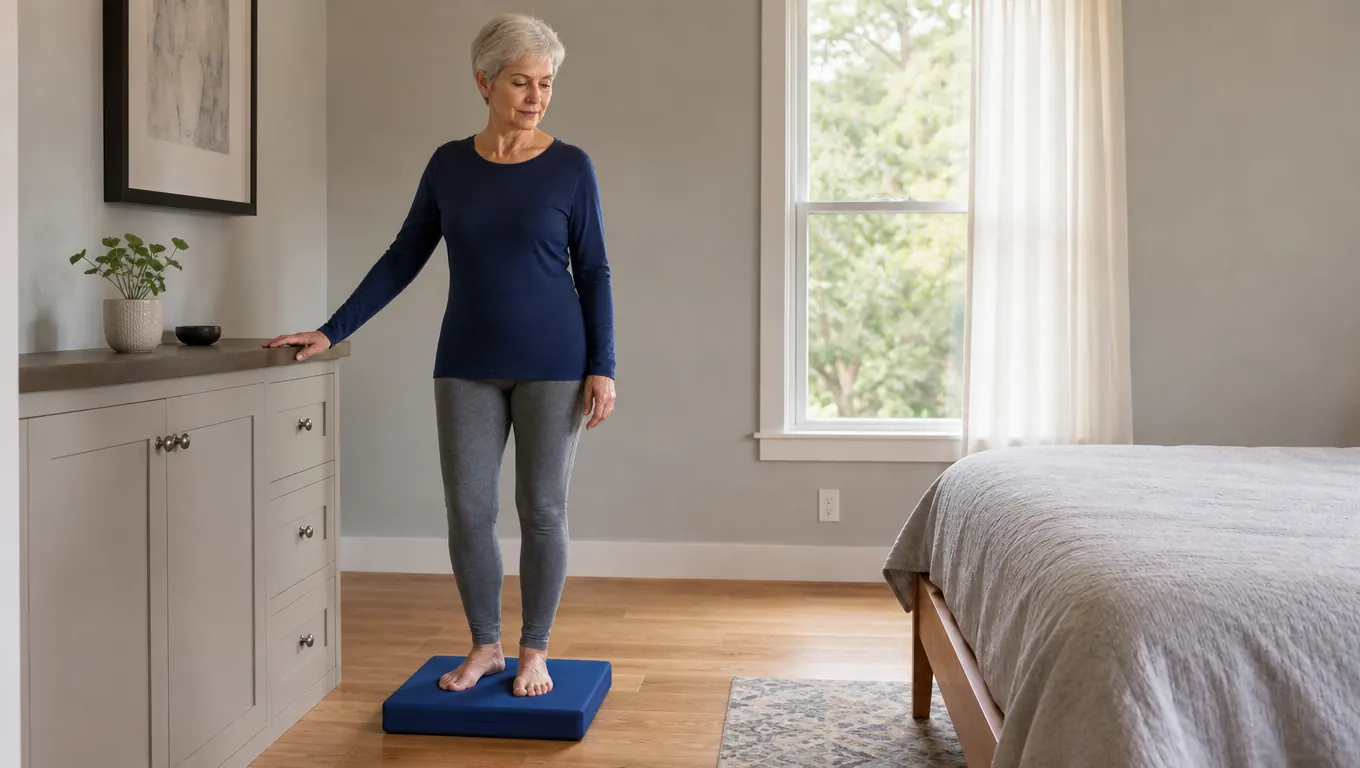
What the foam pad actually feels like
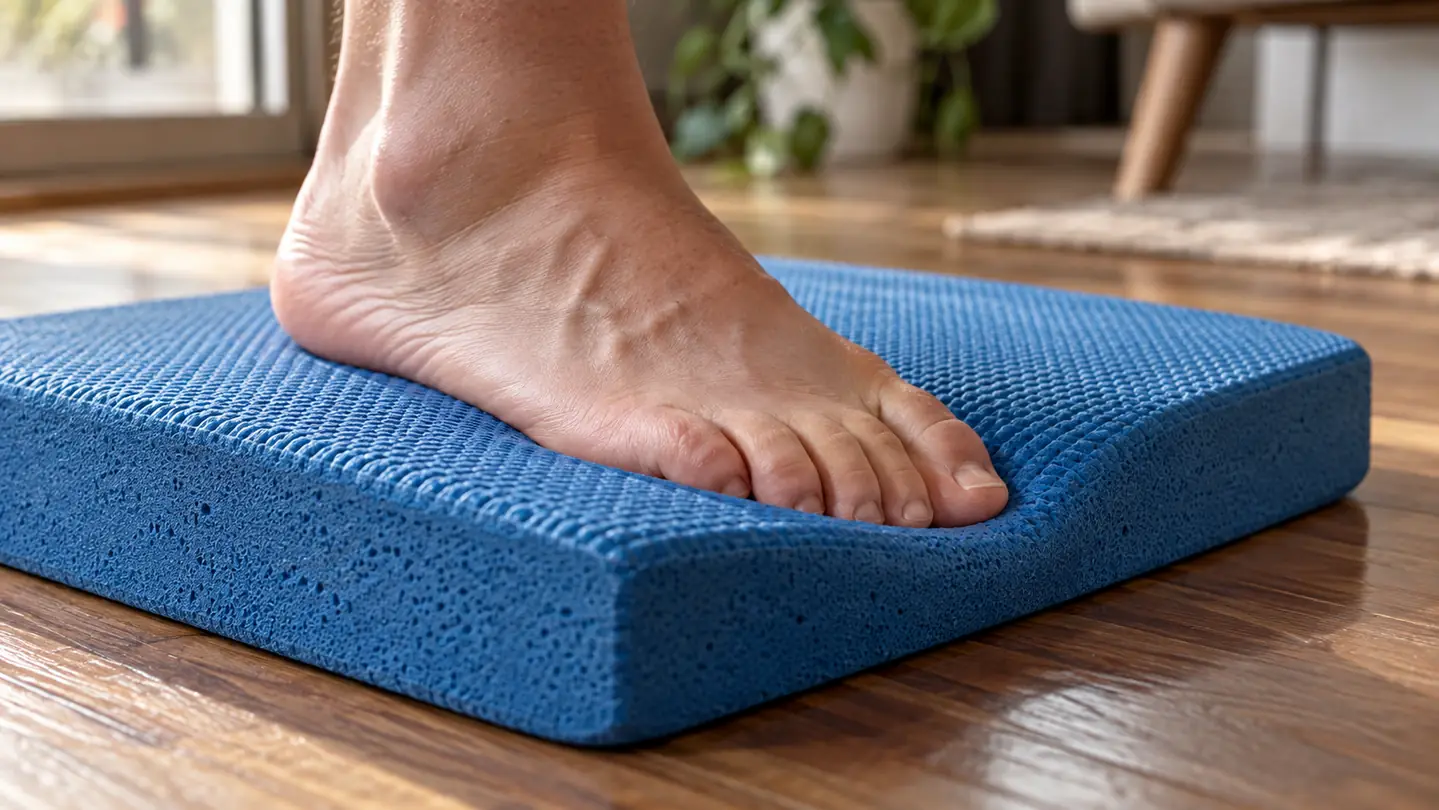
Step onto the ProsourceFit pad and your foot sinks about an inch and a half into it. The foam is dense enough that it does not bottom out under my weight, and it pushes back evenly, so your ankle is working constantly in small corrections rather than making one big save. That is the whole point. Balance is not one dramatic recovery, it is hundreds of tiny adjustments a second that you never notice until they stop happening reliably. I measured the compression with a ruler against the edge one morning out of curiosity. Standing still with my weight even, the foam gave up a bit over an inch and a half under each heel and a little less under the forefoot. Shift your weight forward and that reverses within a second. You can watch the foam telling you where your weight actually is, which is information most of us never get standing on a solid floor.
The surface is textured on both sides, which matters more than I expected. I use it barefoot, and on a March morning in Idaho a cold hardwood floor is not appealing, so a bit of foam underfoot is welcome for its own sake. It stayed put on my floor the entire time. I never once had it slide out from under me, which is the single thing I was most worried about when I ordered it. It also does not absorb water the way a cheap open-cell foam does. I took it out to the garden in May and knelt on it in damp grass for the better part of an hour planting tomatoes, and it wiped off with a cloth and dried by evening. That was not what I bought it for, but it is the sort of thing that decides whether a piece of gear stays in the house.
First session, I stood on it with two feet and both hands on the dresser and lasted maybe forty seconds before my calves started burning. That surprised me. I walk a lot and I assumed my legs were fine. By the end of week two I could stand on it two-footed with no hands for a full two minutes while I brushed my teeth, which is where this ended up living in my routine. By week six I was doing single-leg work on it, thirty seconds a side, one hand hovering near the dresser but not touching it.
The progression was steady and it was measurable, and that is the part that kept me doing it. I could tell in a given week that I was better than the week before, because the clock said so.
The pad asks you a question you can answer. The cushion asks you one you cannot, yet, and that difference decides whether the thing gets used.
What the wobble cushion actually feels like
The cushion is a different animal. It is a disc of air, and air moves. When you put weight on one edge, the air goes somewhere else, and the disc tips to follow it. There is no even resistance the way there is in foam. There is a tipping point, and you are either inside it or you are stepping off.
My first attempt lasted about six seconds. My second lasted four. I want to be honest about how discouraging that was, because I think it is the thing nobody mentions. I had been standing on the foam pad for three weeks by then and felt quite pleased with myself, and the cushion made me feel like I had made no progress at all. I put it in the closet for eleven days. I tried every trick I could think of first. I tried it against the wall, which just meant I was leaning on the wall. I tried two hands on the dresser, which meant my arms were doing the work and my ankles were doing nothing at all. I tried it in socks once, which I do not recommend to anyone and will not describe further. None of it helped, because the problem was not my technique, it was that the thing was set up harder than I was ready for.
What eventually made it work was dropping the air pressure. Mine came inflated harder than it needed to be. I let out enough air that the disc sat noticeably flatter, and suddenly it was a tool I could use instead of a test I kept failing. That adjustability is the cushion's genuine advantage over foam, and it is the one thing the pad cannot do. A foam pad is as hard as it is forever. A cushion can be tuned to exactly where you are this month and re-tuned in June.
Where each one is clearly better
The pad wins on two-footed work, on anything where you want both feet on the surface at once, and on every exercise where you are moving rather than just standing. Squats, weight shifts side to side, standing and reaching for something on a shelf. It is big enough to actually stand on with normal foot spacing. The cushion is round and small, and two feet on it means your feet are touching, which is a harder starting position than most people want and is not how anyone stands in real life.
The cushion wins on single-leg ankle work and on anything seated. I did not expect the seated part to matter and it turned out to be the reason I kept it. Sitting on it in a hard kitchen chair while I shell beans or read keeps small postural muscles working through an otherwise still hour. That is a genuinely different benefit, and the foam pad cannot do it at all. I sat on it for an hour most afternoons through April while I was putting up preserves and reading, and by the end of that month my lower back was noticeably less stiff when I stood up from a long sit. I cannot prove the cushion caused that and I am not going to pretend otherwise, but it was the only thing that changed.
The pad also doubles as a knee pad, which I use more than the balance work some weeks. It went out to the garden with me in May for planting, and it is the thing I kneel on for floor stretches. The ProsourceFit pad is thick enough that kneeling on hardwood stops being unpleasant, and that made it the most-used object in the room by a wide margin.
The honest failure points
The foam pad has taken a permanent dent where my right heel lands. It is cosmetic and it has not got worse since about month two, but it is there and it will not come out. The foam also picks up dust and needs wiping with a damp cloth every couple of weeks, and it holds a faint new-foam smell for the first week or so out of the box.
The cushion loses air. Not dramatically, but enough that I was topping it up roughly every three weeks, and the difficulty changes underneath you as it softens, so a session in week three of an inflation cycle is not the same session as week one. It also squeaks against a hardwood floor and skates a little if the floor has any dust on it, which is exactly the wrong behaviour from a balance product. I ended up putting it on a mat.
How I would buy these today
Start with the foam pad and give it eight weeks of short daily sessions before you think about anything harder. Two minutes while the coffee brews is enough. The reason is not that the cushion is bad, it is that starting on something you can succeed at on day one is what determines whether you are still doing this in October. I nearly quit the cushion in the first fortnight and the only reason I did not abandon balance work entirely is that the pad was still sitting there being manageable.
Add the cushion later if you want a harder version and a seated option, and deflate it further than you think you should when it arrives. If you are only ever going to own one of these, own the pad. It does more jobs, it needs no maintenance, it stores flat under a bed, and it is the one I have actually used four mornings a week since March.
One safety note that applies to both and that I would not skip. Set up within arm's reach of a counter, a wall or a sturdy chair, and keep that hand available for the first few weeks even when you think you do not need it. Do not use either one on a slippery floor or in socks. Nothing here is medical advice, and if you have had a fall, a recent injury, or any condition that affects your balance, talk to your doctor about what is sensible for you before you start standing on an unstable surface.
If you buy one thing from this comparison
Six months in, the ProsourceFit balance pad is the one still on the floor rather than in the closet. No inflating, no topping up, big enough for both feet, and it works as a knee pad on the days you are not using it for balance at all.
Amazon Check Current Price on Amazon →