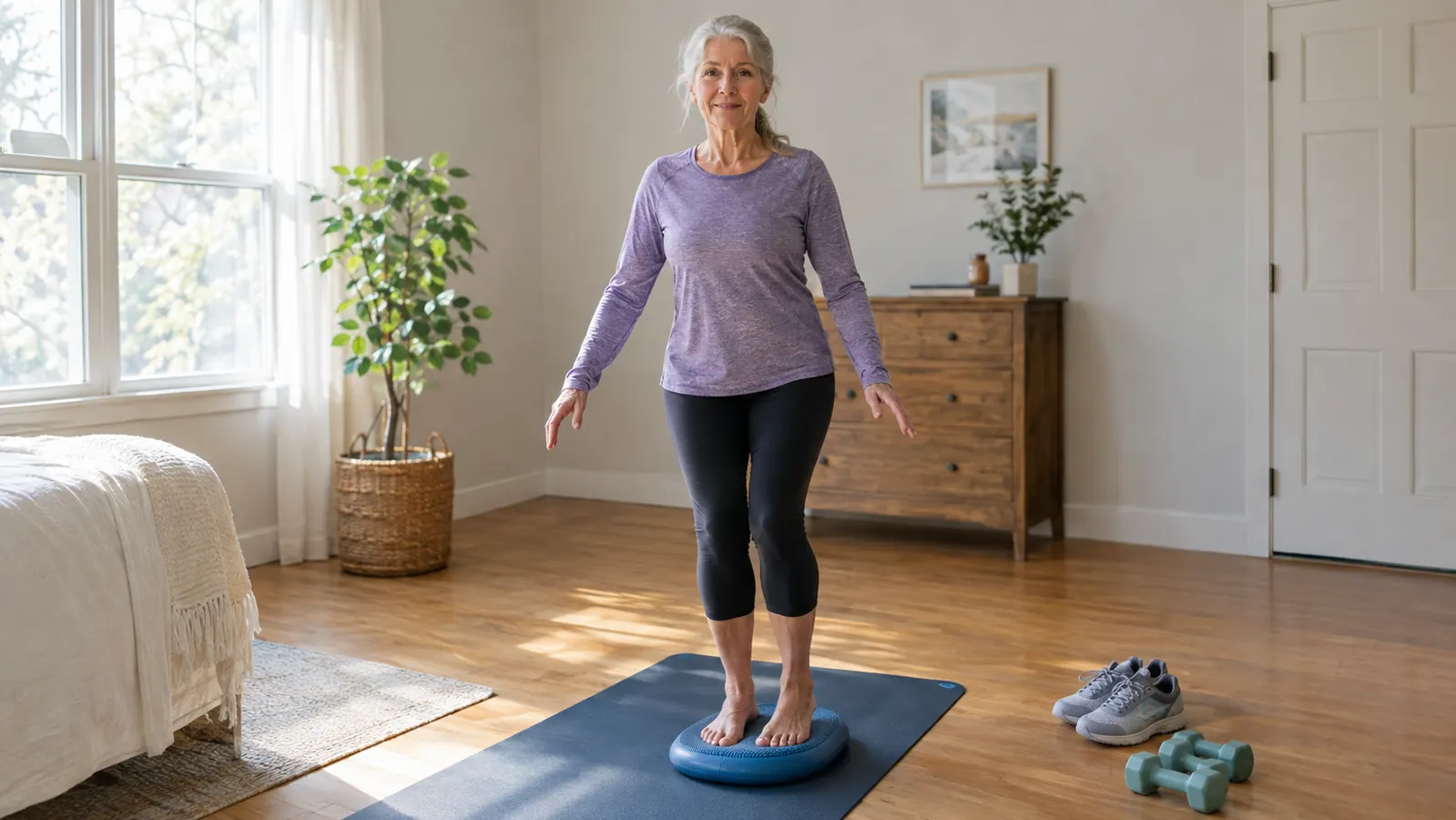
When you pass 55, you start to notice the small things. My left knee complains on the stairs in the morning before I've had coffee. My right shoulder, which I rehabbed after a fall in 2019, still lets me know when I've overdone it in the garden. I walk three or four miles most mornings along the river trail here in Coeur d'Alene, and I do light strength work three days a week in my spare bedroom. Nothing fancy. A mat over a hardwood floor, a couple of hand weights, and a closet that holds it all when I'm done. About six months ago I added a ProsourceFit balance pad to that routine. It has earned a permanent spot on the floor.
I didn't buy it because I wanted to stand on a squishy pad. I bought it because my balance was getting worse in ways I couldn't ignore. Not dramatic. Just enough that I'd reach for the wall in the shower, or slow down on the trail when the ground got uneven. I came across the word 'proprioception' while reading about why people my age lose their footing, and it stuck with me enough that I wanted to do something about it. So I did what I usually do. I read a pile of reviews, asked a few friends, and bought the one that kept coming up. Six months later, this is what daily use actually looks like.
The Quick Verdict
After 180 days of near-daily use, the ProsourceFit balance pad is the one piece of home gear I would buy again without hesitation. It is firm, it stores flat, and it has steadied both my balance and my confidence on uneven ground. It is not a replacement for walking or strength work, but it does exactly what it promises.
Amazon Check Today's Price →The pad that held up through six months of daily use
If you want to work on balance without leaving the house or joining a gym, this is the one I kept using. It is small, it stores flat, and it does not need any setup. Check today's price before you decide.
Amazon Check Today's Price on Amazon →How I've Used It
I bought the pad in early March, right before the ground thawed here. Most mornings I use it for ten or twelve minutes after my walk, before I do anything with weights. I start with both feet, then move to a single leg, then try it with my eyes closed for a few seconds. Twice a week I do the same routine while I brush my teeth, which sounds odd but makes the time disappear. The pad lives on the floor of the small room, and on days I skip it I can feel the difference in my knees by the next morning.
I also use it as a knee pad when I'm working in the garden or canning tomatoes in September. The flat side down over a bucket or on the ground is genuinely more comfortable than kneeling on bare dirt. I did not buy it for that, but it has saved my knees on more than one Saturday afternoon. That versatility is part of why it stayed out instead of going back in the closet.
A few mornings a week I add a forward reach. I stand on the pad with both feet, hinge at the hips, and reach toward the floor as far as I can without moving my feet. It stretches my hamstrings and makes my ankles work harder than you would expect. I found that one in a beginner routine online, and it has become my favorite part of the session. I also do small circles with each foot while standing, which sounds silly but wakes up the muscles around my ankle.
What the Pad Actually Is
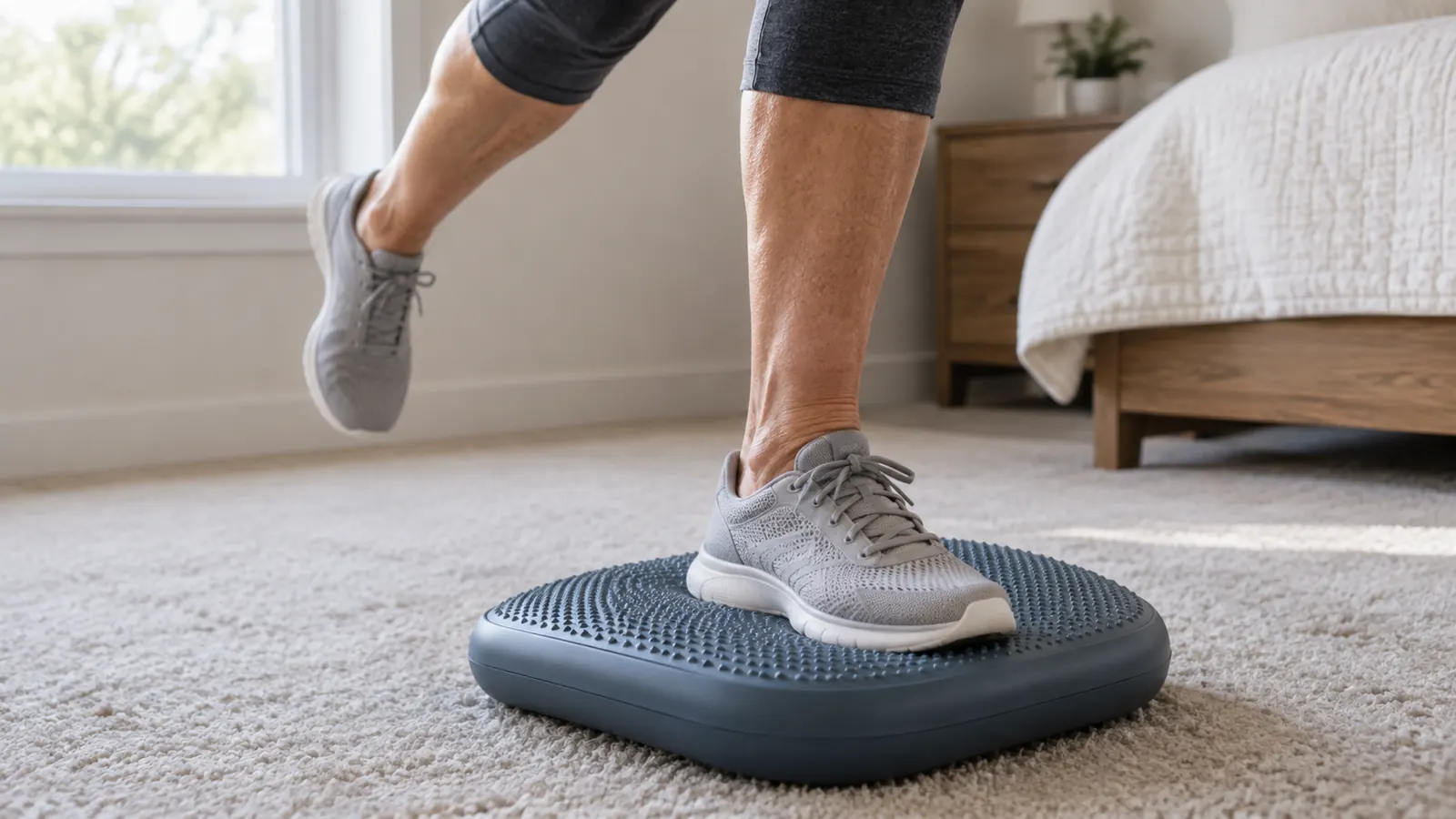
The ProsourceFit balance pad is a square of dense foam, about the size of a large floor tile, with a raised, textured top and a flat underside. It is firmer than a couch cushion and softer than the floor. That middle ground is exactly what you want. A pad that is too soft lets you sink and does little for your ankles. One that is too hard does not challenge you at all. This one sits in the sweet spot, and after six months it still has the same spring it had on day one.
The textured top gives your bare feet something to grip without being uncomfortable. I tried it in socks, in bare feet, and in my walking shoes. Bare feet worked best. The pad does not slip around much on my mat, though on bare hardwood it will slide a few inches during single-leg work. A cheap rug pad or a mat underneath solves that. I keep mine on the mat and it stays put.
It weighs almost nothing, which matters more than you think when you are moving it from the closet to the floor and back again. Mine has spent six months on the floor of the small room and shows no signs of flattening or tearing. I have dropped it, stepped on it with my walking shoes, and once left it in the sun on the porch by accident. It came back inside looking the same as when I bought it.
Cleaning is simple. A damp cloth wipes off dust and dirt, and it dries fast. I wipe mine down once a week when I do the floor of the small room. After six months it still looks like the day I unpacked it, which is more than I can say for most of the foam things I have bought over the years.
What Changed After 30, 90, and 180 Days
I keep a small notebook in the drawer of my nightstand, and I wrote down what I could do each month. On the first Tuesday in April, I could hold a single-leg stand on the pad for about ten seconds before I had to put my foot down. By the Fourth of July I was at 45 seconds. By September I could do 60 seconds on my left leg and almost that on my right, and I could close my eyes and hold 20 seconds without wobbling off.
The bigger change was off the pad. Around day 60 I noticed I was not reaching for the wall in the shower anymore. By the end of the summer I was walking the rocky sections of the river trail without slowing down, the way I used to before my knee started complaining. I cannot say the pad alone did all of it. Walking and the light strength work did their part. But the pad is the one thing I added that I have not skipped.
The stairs were the quiet win. My left knee used to make me grip the railing on the way down in the morning. Around the three-month mark I realized I was taking the stairs without thinking about them at all. Nothing dramatic, just a small thing that made the day easier. I also noticed it on Thursday nights at swing dance. The class had been a little hard on my balance since I turned 60, and lately I have been holding my turns steadier and laughing more when I stumble.
Where It Annoyed Me
It is not perfect, and I would not want you to buy it expecting perfection. The first week there was a faint foam smell in the small room. It faded by the end of week two, but it was there. The pad also slides a little on bare hardwood, which is why I keep it on my mat. And the wobble takes getting used to. The first few days my ankles complained in a way I had not felt in years. That is the point, but it is worth knowing before you start.
The other honest limitation is that it is not a substitute for walking or strength work. It will not fix a knee that needs real attention, and it will not build the muscle that keeps you steady on your feet. It is a small, consistent addition to a routine that is already doing the heavy lifting. If you expect it to do everything, you will be disappointed.
The pad is also a little small for some exercises. If I try to stand with my feet wide apart, my heels hang off the edge. That is not a problem for the balance work I do, but if you are a taller person or you like your feet spread wide, you may want to check the size before you order. I have never found it a reason to stop using it. It just means I do my footwork with my feet together.
What I Tried Before This
Before I bought the ProsourceFit pad, I tried three things that did not work. First, a folded bath towel on the floor. It was too soft and did nothing for my ankles. Then a couch cushion, which was worse, because it sank and rolled. A friend lent me a round wobble cushion, the kind with the bumpy air bladder. That one was too unstable for me. It made my left knee ache after a few minutes, and I stopped using it. The ProsourceFit pad is the middle ground I was looking for, firm enough to be stable and soft enough to be comfortable.
I mention this because if you are older and shopping for balance gear, you will see a lot of options. The very soft ones feel nice and do little. The very unstable ones feel hard and can hurt. A flat, firm pad like this one is where most people over 55 should start. You can always move to something harder later if you want more of a challenge.
One more thing worth saying. I read a good deal about balance work before I bought anything, and what I read matched what the reviews said. Start flat and firm, not squishy and not wobbly. She also said to expect slow progress and not to quit after a week. I am glad I listened. The first month felt like nothing was happening, and then all at once the small improvements showed up in everyday life.
What I Liked
- Firm but forgiving surface, steady underfoot
- Stores flat in a closet or under a bed
- Held up to daily use for six months with no tears or flattening
- Easy to clean with a damp cloth
- No assembly, works on a mat or bare floor
Where It Falls Short
- Slides a little on bare hardwood without a mat
- Takes a week or two to get used to the wobble
- Not a substitute for walking or strength work
- Textured top feels grippy on bare feet at first
On the first Tuesday in April I could hold a single-leg stand for ten seconds. By September it was sixty, and I stopped reaching for the wall in the shower.
Who This Is For
Buy this if you are past 55, you want to work on balance at home, and you have a corner of a room or a closet shelf to spare. It is ideal for people who walk most days and want to add a few minutes of steadiness work without a gym membership or a trainer. It is also great if you garden, because the flat side makes a comfortable knee pad. If you already do light strength work in a spare room, this is the natural addition to that routine.
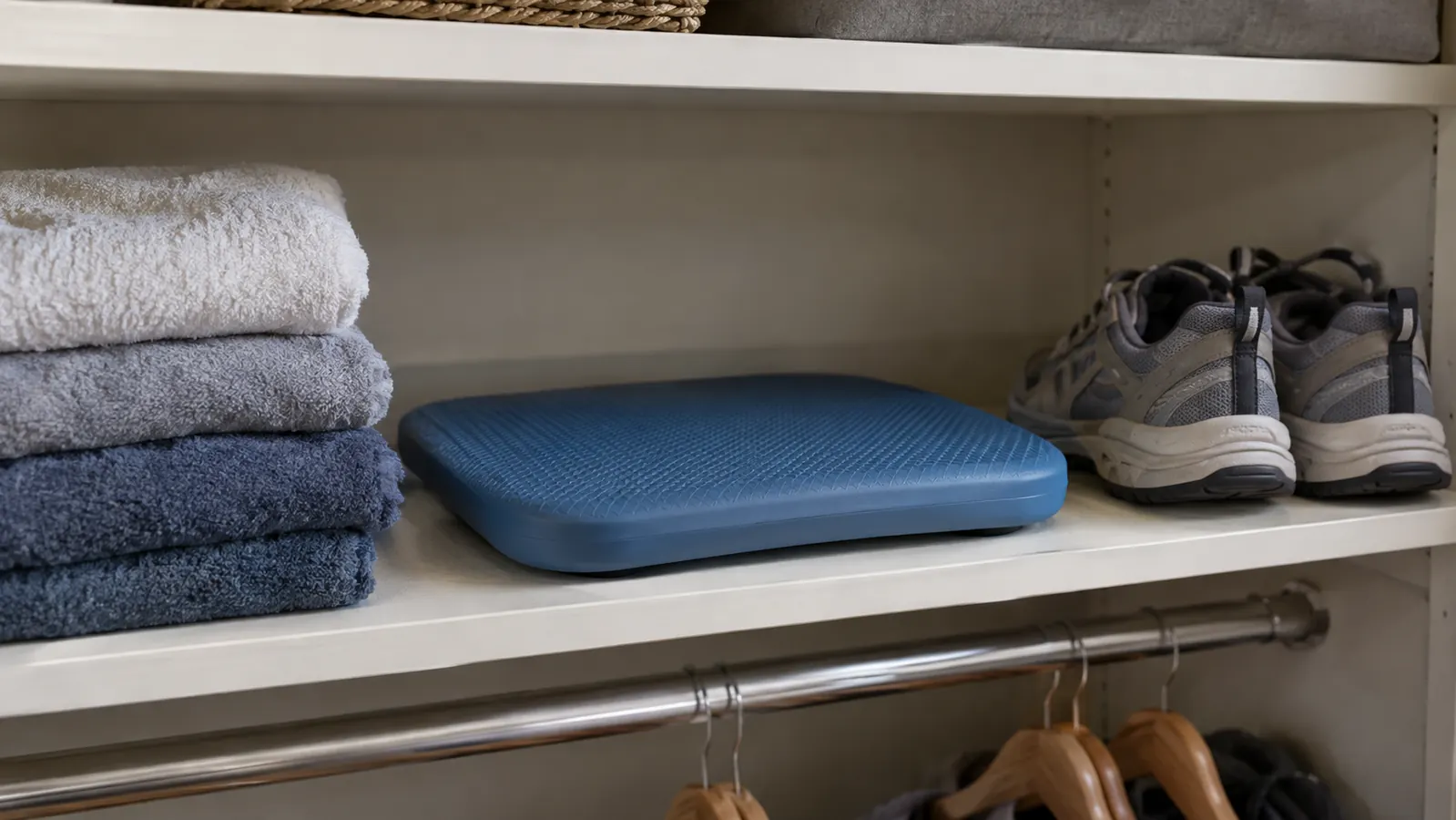
For my setup, it is perfect. The small room is roughly ten by eleven feet with a mat over the hardwood, and everything has to fit back in a closet when I am done. The pad slides onto a shelf next to my folded towels and takes up no real space. There is no assembly, no charging, no maintenance. That is exactly the kind of gear a person actually keeps using.
Who Should Skip It
Skip it if you have a foot or ankle injury that a doctor has told you to rest, or if you are not ready to spend a few minutes a day on balance work. A pad you use once a month will not help. Skip it also if you are hoping for a quick fix for a serious balance problem. This is a tool for steady, daily improvement, not a cure. If you have real concerns about falling, talk to your doctor or a physical therapist first.
If you already have a wobble cushion or a round balance disc and you like it, you do not need this one too. And if your only plan is to stand on it once a week while you watch television, save your money. The benefit comes from daily, even brief, use. Ten minutes most mornings is enough. Less than that, and you will not see the changes I did.
Six months in, I would buy it again
The ProsourceFit balance pad is small, sturdy, and easy to live with. If you are shopping for your first balance tool and you want one that will actually get used, this is the one. Check today's price and see if it fits your room and your routine.
Amazon Check Today's Price on Amazon →