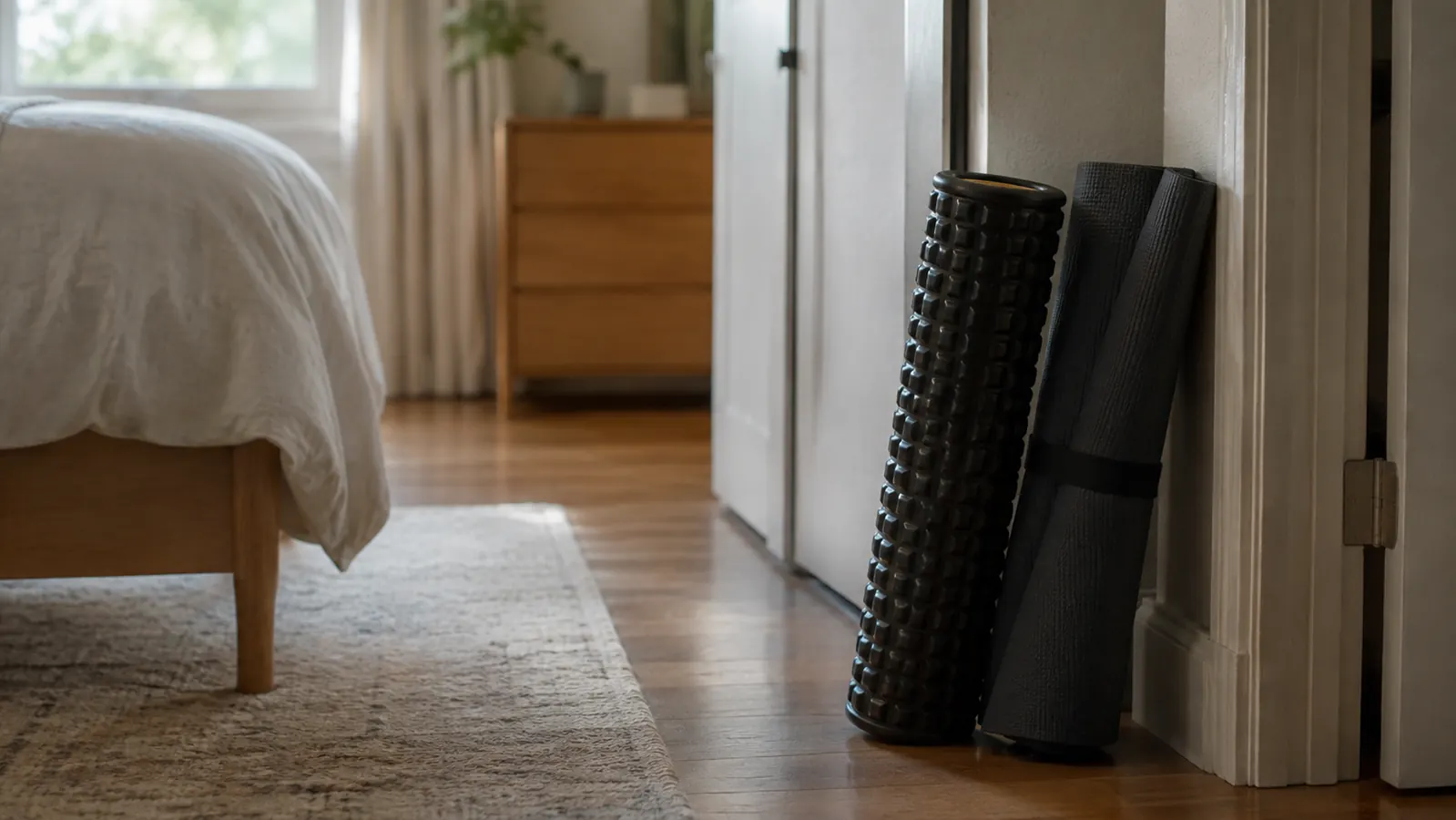
I did not buy a foam roller because I was training for anything. I bought one because my calves ached after a three mile walk along the river trail, and my lower back complained every time I spent an afternoon on the hardwood floor doing light strength work. My neighbour Carol let me borrow her TriggerPoint Grid roller one Thursday in March. I used it for ten minutes on the couch, and I ordered my own that same evening. That was six months ago, in the spring. It still works like new, and I still use it three or four times a week, usually in the evening after dinner. I keep it propped against the door frame in the closet, next to the folded mat, so it does not roll around and hit my ankles.
This is not a guide for people who run marathons. This is for the rest of us. If you walk most days, if you do a few exercises in a spare room, if you wake up with tight calves or a stiff lower back after a long day, this routine is for you. It takes about fifteen minutes. You can do it on the floor in front of the television. And you do not need a gym membership, a trainer, or any special clothing to make it work.
The roller that finally loosened my tight calves
The TriggerPoint Grid 1.0 is the roller I reach for three times a week. It is firm enough to do the work and kind enough to my knee. I have had mine for six months, and it has not flattened, cracked, or complained.
Amazon Check Today's Price on Amazon →Step 1: Start with your calves, the place most of us feel it first
Calves are where I notice tightness first, usually the morning after a long walk. Mine tighten up about four hours after I come home, and by the next morning they feel like cords. Rolling them is the simplest part of the routine, and it is the part that convinced me this whole idea was worth my time. I have used this roller on my calves, my thighs, and my back, and the calves are where I feel the payoff fastest.
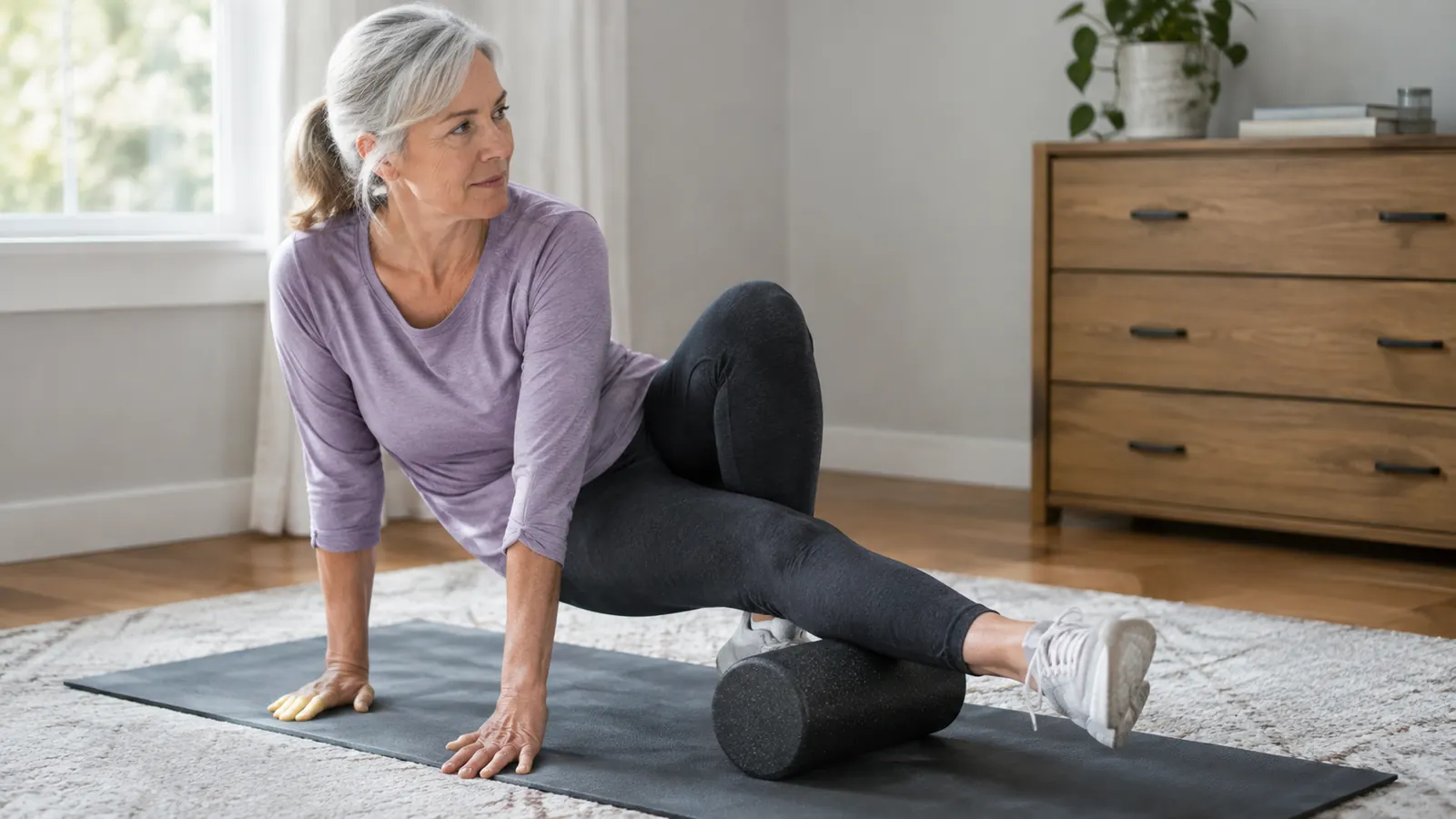
Sit on the floor with your legs out straight in front of you. Place the roller under one calf, just below the knee. Prop yourself up on your hands, lift your hips an inch or two, and roll slowly from the knee down to the ankle and back up. Go slow. A full pass should take about five seconds in each direction. When you find a spot that feels tender, and you will, hold there for twenty or thirty seconds and breathe. Keep your foot relaxed, not pointed. A pointed foot makes the calf tighter. If the floor is slippery, put a yoga mat or a folded towel under the roller. Mine stays put on the mat I already own, so I do not bother.
The first time I did this, I found a spot on my left calf that made me wince. I held it for about twenty seconds, and when I stood up, that leg felt lighter. Not looser, exactly. Lighter. The next morning, the usual grumble on the stairs was gone. That was the moment I stopped borrowing Carol's roller and bought my own. Do both calves, two minutes on each side. If you want more pressure, stack your other leg on top of the working leg. If you want less, keep both feet on the floor. I usually start with both feet down and add the leg on top halfway through.
Step 2: Move to the front of your thighs
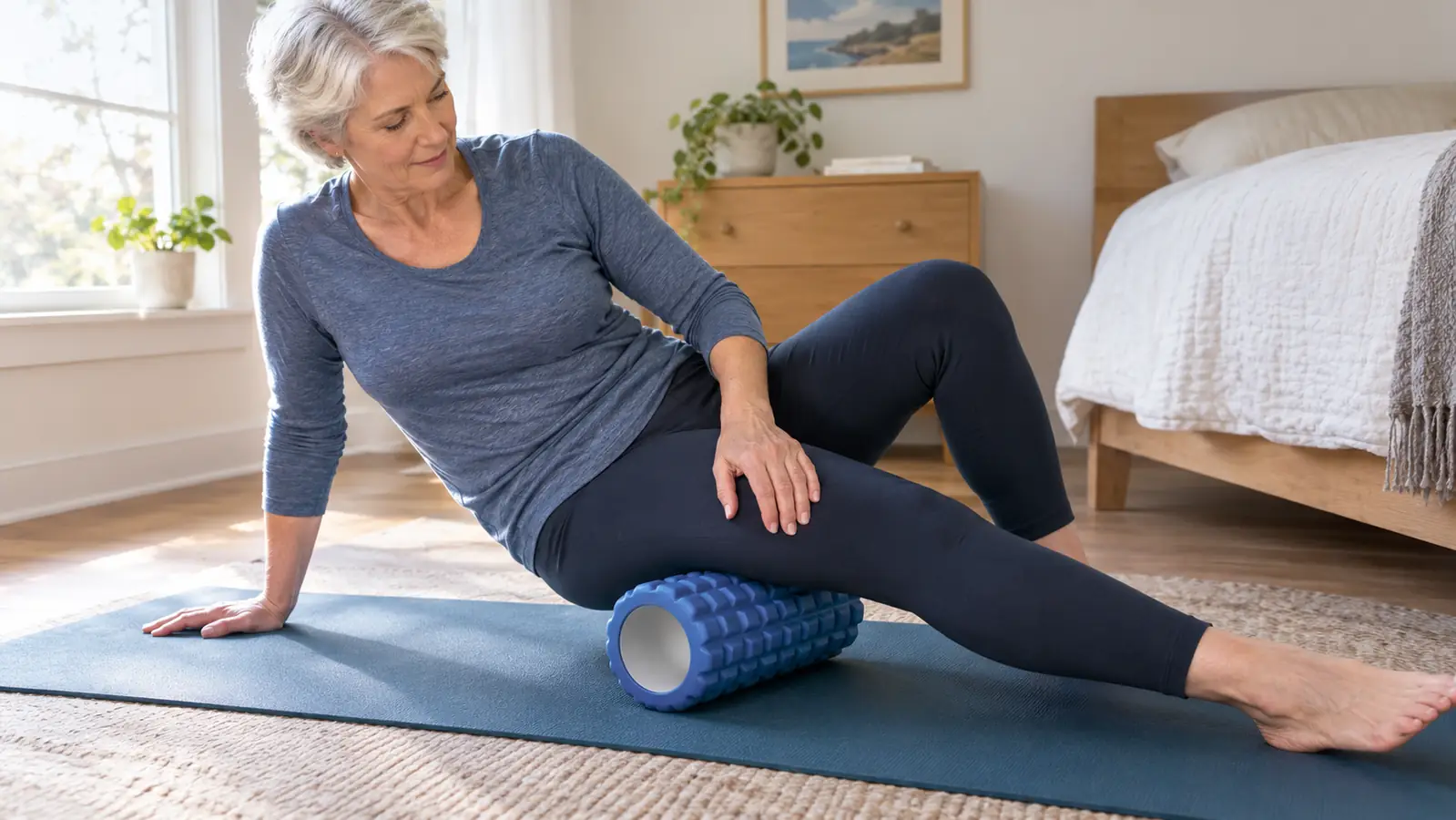
The front of the thigh, the quad, is the muscle that does most of the work when you walk uphill or stand up from a chair. If you have done any floor exercises recently, squats against the wall or step ups, this is where you feel it. Rolling the front of the thigh is a little awkward at first, but it gets easier quickly. I notice it most after I have been standing at the counter canning tomatoes in September, because that is a lot of time on my feet.
Lie on your stomach with the roller under one thigh, just above the knee. Support your upper body on your forearms. Roll from the knee up toward the hip, slowly, about five seconds per pass. Keep your hips level and let your weight do the work. You do not need to push hard. The weight of your own leg is enough. If the roller slides, you are going too fast.
I learned this the hard way. In March, after a week of doing step ups on the bottom stair, my right thigh was so tight I could barely bend it. I rolled it for three minutes that evening, wincing the whole time, and by Friday I could sit cross legged on the floor again. My right shoulder, which I rehabbed after a fall in 2019, does not love the forearm position, so I switch to my fists when my shoulder starts to complain. Two minutes per leg is plenty. If the floor is hard, put a folded towel under your forearms. I keep an old bath towel folded in the closet for exactly that.
Step 3: Roll the back of your thighs, gently
The hamstrings are the muscles under the back of your thigh, and they are often tighter than people expect. If you sit for part of the day, even at a desk or a kitchen chair, they shorten. If you then go for a brisk walk, they do a lot of work. Rolling them helps, but you have to be gentle. The hamstrings do not like heavy pressure.
Sit with the roller under one hamstring, just below the glute. Prop yourself on your hands and roll from the back of the knee up toward the hip. Go even slower here, about seven seconds per pass, and keep your leg relaxed. Do not lock your knee. If a spot is tender, hold for fifteen seconds, then move on. Do not camp on one spot for minutes at a time. That is how you bruise yourself. Your hands will do the work of lifting you, so keep your palms flat and your shoulders relaxed.
The first month I had my TriggerPoint roller, I rolled my hamstrings too hard and too fast. I woke up with bruises the size of walnuts. My neighbour Carol told me to slow down and lighten up. She was right. Since I started going slow and light, I get the benefit without the marks. One minute per leg is enough. If you have had any knee trouble, keep your toes pointed up and your knee slightly bent the whole time.
Step 4: Your lower back, done lying down
Your lower back is the reason many people buy a foam roller in the first place, and it is the area where I see the most mistakes. People roll their back like they roll their calves, directly on the spine, and then wonder why it hurts more. The right way is different. You do not roll your spine. You roll the muscles on either side of it. It is also the area people rush, because it is uncomfortable.
Lie on your back with the roller under your lower back, just above your hips. Bend your knees and keep your feet flat on the floor. Cross your arms over your chest. Lift your hips just an inch, and rock side to side, from the right side of your spine to the left, slowly. You are not rolling up and down. You are rocking sideways, one tender muscle at a time. Do this for about ninety seconds, and keep your head down on the floor, not propped up.
The first time I tried this, I felt a knot on the right side of my lower back that had been there for months. Nobody had ever told me it was there. After about a minute of rocking on it, the knot softened, and I could stand up straighter. My lower back is the reason I keep this routine even on weeks when I have not walked much. If anything feels sharp, stop. A dull ache is normal. Sharp pain is your signal to see a professional. I do this step last on nights when my back is quiet, because it finishes the whole session on a calm note.
Step 5: Finish with your glutes and call it done
The glutes, the muscles you sit on, are the last stop in this routine. They get tight from sitting, from walking, and from any kind of squat or lunge. Rolling them is not elegant, but it is effective, and it is the step that makes my Thursday swing dance class feel easier.
Sit on the roller with it under one glute, around the sit bone area. Lean to one side so your weight is on that glute, and prop yourself on that hand. Roll in small circles, not big passes. You are looking for the tender spots and holding each one for about twenty seconds. Then switch sides. Two minutes per side is plenty. If the roller feels too firm on the glutes, sit on the edge of a folded blanket first.
My left glute has a knot that has been with me for years. I do not know where it came from, probably years of sitting at a school administrator's desk. Rolling it takes the edge off, and it keeps my knee happier on the stairs. My left knee complains on stairs and after long drives, and I have found that when my glute is loose, my knee is quieter. That is not science I can prove. It is just what I have noticed over six months. After you finish both sides, stand up slowly and take a few steps. Drink some water. The routine is done. Some evenings I skip this step if I am tired, and I notice it the next day.
What Else Helps
Foam rolling is not the whole answer. I drink more water on days I roll, and I have found it helps. I also stretch my calves against the wall after my walk, before I roll, which makes the rolling easier. And I have learned that the best time to roll is the evening, after dinner, when I am not in a hurry. If I roll first thing in the morning, I am too tight and it hurts. In the evening, it is comfortable and I sleep better. I also make a point of standing up and moving every hour when I am working at the kitchen table, because sitting still makes everything tighter. None of this is complicated. It is just what has worked for me.
A foam roller is a tool, not a cure. It will not fix a real injury, and it will not replace a doctor's advice. But for the everyday tightness that comes with being 62 and still walking three or four miles most mornings, it has made a real difference. My TriggerPoint Grid has been in my closet for six months, through an Idaho spring and a move of furniture, and it still feels as firm as the day I bought it. That is the kind of thing I care about. I would rather buy one good tool that lasts than three cheap ones that flatten. The grid pattern has held up, the foam has not dented, and it does not roll away on me when I set it down. I have recommended it to two friends, and both bought their own within a month.
The morning after I rolled my calves for the first time, the usual grumble on the stairs was gone. That was the moment I ordered my own roller.
Fifteen minutes, three or four times a week, no gym required
The TriggerPoint Grid 1.0 is the roller I have used for six months. It is firm, it is sturdy, and it stores flat in my closet. If you are tired of waking up tight, this is a good place to start.
Amazon Check Today's Price on Amazon →