
I bought my first pair of Yes4All neoprene dumbbells on a rainy Tuesday in April 2025. I was 60 years old, my left knee had been complaining on stairs for a year, and I had finally admitted the thing every retired person over 55 works out eventually: you need to lift something. Not heavy. Just something, a few times a week, to keep your grip, your shoulders, and your legs honest. I live alone in a house in Coeur d'Alene, Idaho, with one spare bedroom that is roughly 10 by 11 feet, a hardwood floor with a mat over it, and no interest in a gym membership. No garage gym, no rack, no treadmill. Everything I own for exercise has to live in a closet or under a bed, because that room also holds my sewing table and, in September, my canning kettle and a bushel of tomatoes.
Here is the short answer to the question I get from friends my age who want to start lifting at home: for a beginner over 55 doing light strength work in a small room, a set of fixed neoprene pairs like the ones Yes4All sells is the better first buy. An adjustable set like the Bowflex SelectTech is a genuinely good tool. It is also heavier, bulkier, and more expensive, and most people my age never actually outgrow the fixed weights. I will walk you through exactly how I decided, what I measured, and what I would tell my neighbour over the fence.
How I Tested Both in the Same Room
I did not test these side by side in a laboratory. I did something more useful. I bought a pair of Yes4All 5 lb dumbbells in April 2025 and used them three days a week all summer. In September I added the 8 lb pair. Then, in mid-October, a friend who was traveling for a month loaned me her Bowflex SelectTech 552 set, the most popular adjustable dumbbell on the market. I used it the same way, in the same room, on the same mat, doing the same exercises: bicep curls, shoulder presses, rows, and a few slow goblet squats. I kept a small spiral notebook on the windowsill and wrote down three things after every session: what hurt, what wobbled, and what I had to move out of the way.
The notebook told a clear story by the time my friend came home in November. The moment that decided it for me was a Tuesday in late October. I had come back from a long drive, my knee was stiff, and I wanted a quick 15 minute set before dinner. I walked to the closet, took the 8 lb pair off the shelf, and was mid-curl two minutes later. The Bowflex sat on its stand in the corner all week and I did not touch it once. The Bowflex went back to my friend on the first Saturday of November. I still own the Yes4All pairs, and I added a 10 lb pair in January. That decision is the whole review, really. But I want to be fair to the adjustable set, because there are people for whom it is the right call, and you should know whether you are one of them before you spend your money on either.
| Yes4All Neoprene Pairs | Bowflex SelectTech 552 | |
|---|---|---|
| Storage | Pairs stack flat in a closet or under a bed | Needs floor space or a stand |
| Weight range | Fixed weights, you buy pairs as you need them | 5 to 52.5 lb per handle in one set |
| Adjustability | None, grab and go | Turn a dial to change weight |
| Grip | Soft neoprene coating, warm and non-slip | Metal and plastic handle, cooler and harder |
| Moving parts | None, nothing to jam | Dial mechanism can stick if dropped |
| Cost to start | A single pair is a small purchase | One set is a large purchase |
| Best for | Beginner and light strength work | Progressive heavier lifting |
Where Yes4All Wins
The first reason is the room itself. My spare bedroom is 10 by 11 feet. The exercise mat takes up most of the middle, and my sewing table sits against one wall. The Yes4All pairs live on a low shelf in the closet, two pairs stacked, and the rack version would hold them flat on the floor against the wall. When I finish a set, I put them back. Thirty seconds, done, and the room looks the same as it did before I started. The Bowflex, by contrast, is a pair of bulky handles that each top out over 50 lb. On my friend's stand it took up a corner about the size of a small end table, and I had to step carefully past it every time I crossed the room. In a space that small, floor space is the thing you run out of first, and the fixed pairs simply disappear when you are done.
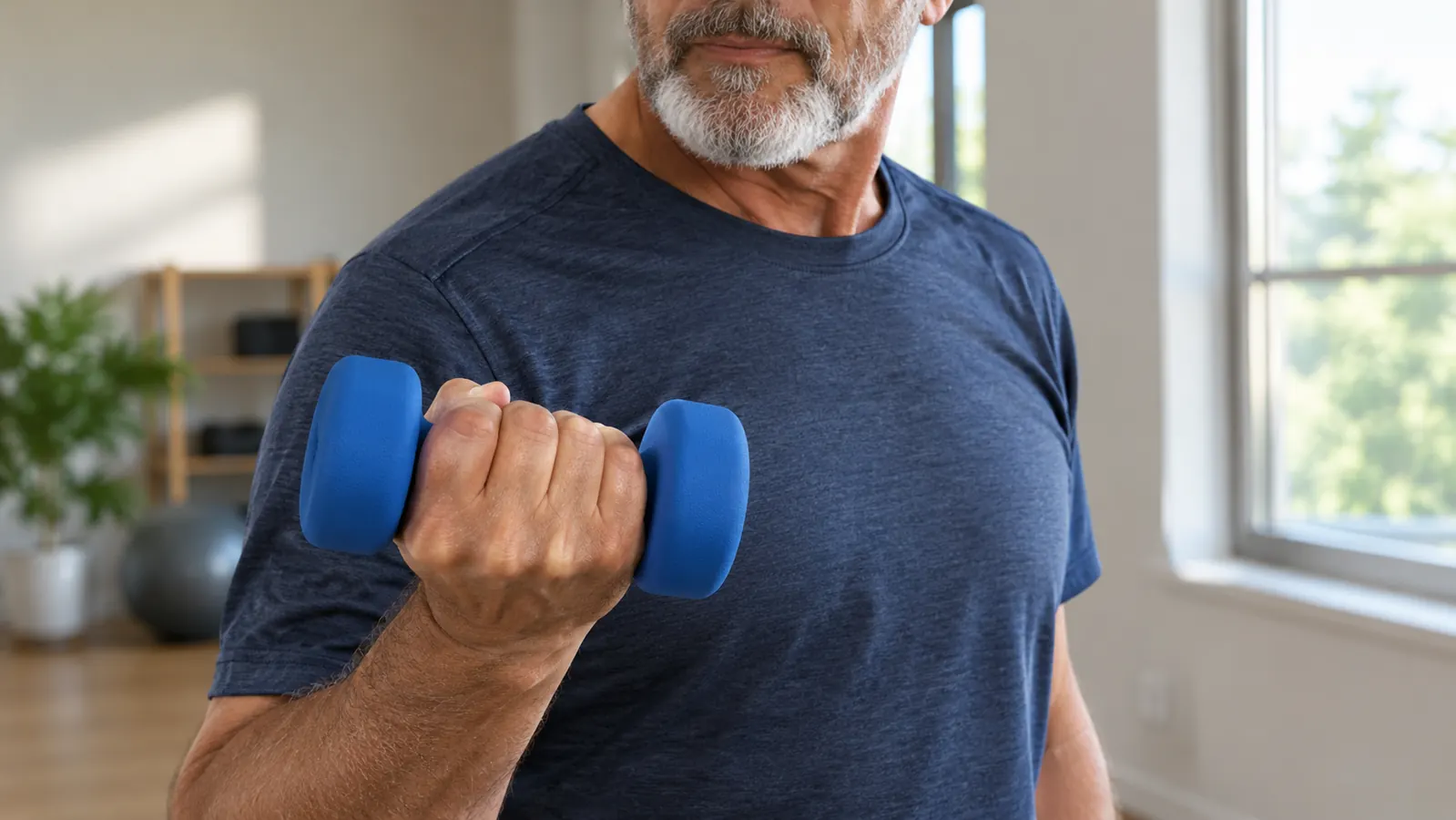
The second reason is grip. Neoprene is a soft, slightly rubbery coating that warms up in your hand and does not slip, even on a dry winter morning when my skin is cracked from the cold. One morning in February, with the temperature at 14 degrees and the house dry from the wood stove, I did my whole set with the 8 lb pair and my hands never complained. That matters to me because of my right shoulder. I rehabbed it after a fall in 2019, and I have to hold a weight with a steady, neutral wrist or the joint complains the next day. The Yes4All handle is comfortable enough that I can do 15 slow bicep curls without my hand cramping. The Bowflex handle is a harder plastic and metal bar. It is perfectly serviceable, I will say that plainly, but on a cold morning it is less pleasant, and for anyone with arthritis or grip concerns, the softer surface is simply kinder to the hand.
There is also the money question, which I think about the way a retired school administrator thinks about everything. A single pair of Yes4All dumbbells is a small purchase. I bought one pair, used it for months, and bought the next when I was ready. The Bowflex is one large purchase that sits in the corner whether you use it or not. I have watched too many friends buy expensive exercise equipment in January and sell it at a garage sale in June. Starting small means the only thing you have committed is the cost of one pair, and if you quit, you have lost very little.
Where Bowflex Wins
Let me be fair, because the Bowflex is genuinely better at two things, and one of them is weight range. A single SelectTech handle goes from 5 to 52.5 lb, which replaces an entire rack of fixed dumbbells. If you actually want to progress from light to heavy over the years, that range is real value. My Yes4All pairs go up to 10 lb right now. If I ever want 12, I have to buy another pair, and another at 15, and another at 20. The adjustable set never asks you to buy again. For a younger person, or anyone doing serious progressive overload, that single feature justifies the cost and the bulk. I wrote that exact sentence in my notebook in October, and I stand by it.
The second thing is adjustability itself. You set the dial, you lock it, you lift. My friend uses her Bowflex for everything from 5 lb shoulder work to 40 lb squats, all with one pair and a turn of the dial. That is genuinely convenient, and it is the reason so many people love the design. The build quality is also excellent. The dial is smooth, the locking mechanism is positive, and the handles do not wobble when you set them down. My honest note was that if I were 30 and training seriously in a studio with floor space, I would buy the Bowflex without a second thought. It is the better tool for the person who needs a wide range and has a place to keep it.
On a tired Tuesday morning, the dumbbell that lives in the closet gets picked up. The one that needs a stand and a dial stays where it is.
Start with one pair you will actually use
Three days a week of gentle strength work does not need a rack or a dial. A fixed neoprene pair is the lowest-friction way to start, and it stores flat when you are done. The Yes4All set comes as pairs or with a rack.
Amazon Check Today's Price on Amazon →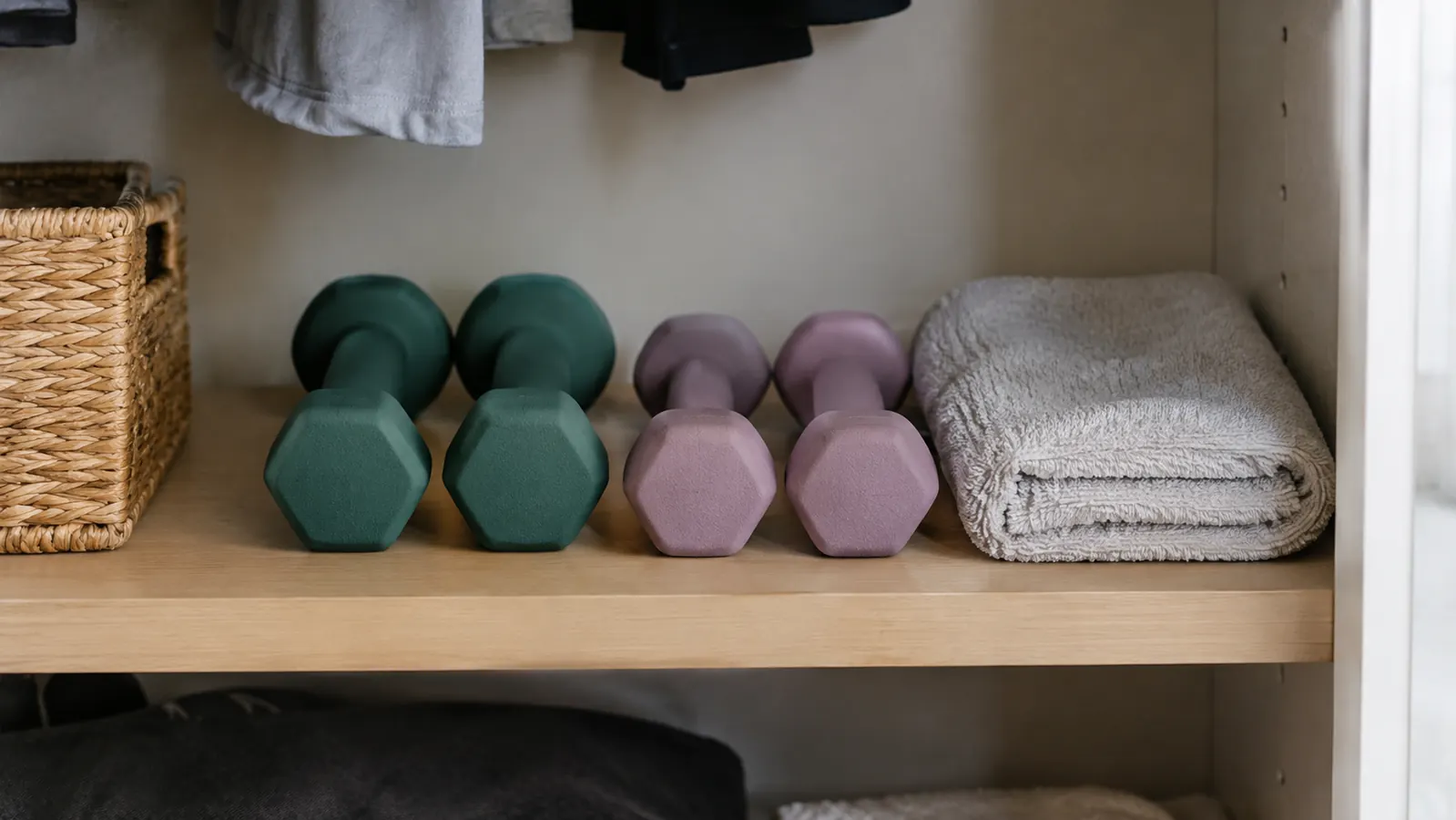
Who Should Buy Which
Here is the decision in plain terms. Buy the Yes4All neoprene pairs if you are over 55, starting strength work for the first time, working in a small room, and your goal is to stay strong for gardening, groceries, and dancing on Thursday nights, not to set personal records. You want something you can pick up on a tired Tuesday without a setup ritual. You want the thing that lives in the closet and comes out in seconds. The fixed pair wins on every one of those points.
Buy the Bowflex, or another adjustable set, if you already know you lift heavy, if you have floor space for a stand, and if you will genuinely use the full weight range. Do not buy it because it sounds more serious, and do not buy it because a friend has one. Buy it because you have a specific plan that needs 25 lb and 40 lb on the same handle. And if you are not sure which camp you are in, buy the fixed pair first. You will not lose much, and the adjustable set will still be there in a year if you outgrow it.
The Honest Downsides of the Neoprene Pairs
I would be doing you a disservice if I pretended the Yes4All pairs have no weaknesses. They have two. The first is the ceiling. Fixed weights mean fixed progress. I am at 10 lb now, and I know that in a few years I will either need heavier pairs or I will hit the practical limit of what I want to do. That is fine for me, but it is a real limitation, and you should see it coming. The second is the neoprene itself. Over a year and a half, the coating on the edges of my most-used pair has started to show a little wear where the weights rest on the shelf. Nothing has cracked or peeled, but it is not a forever material the way solid cast iron is.
There is also a smaller annoyance worth naming. The 5 lb and 8 lb pairs look similar at a glance, and on a low shelf in a dim closet I have grabbed the wrong one more than once. I solved it by putting the heavier pair on the top shelf, but it is the kind of small friction that only comes up with fixed weights. None of these are reasons to avoid the Yes4All pairs. They are reasons to buy them with your eyes open, which is exactly how I bought mine.
The pairs that stayed in my closet for a year and a half
I started with a single 5 lb pair and added a heavier one when I was ready. That is the whole strategy, and it worked. The Yes4All neoprene pairs are the ones I still reach for, three days a week, a year and a half later.
Amazon See the Yes4All Dumbbells on Amazon →