
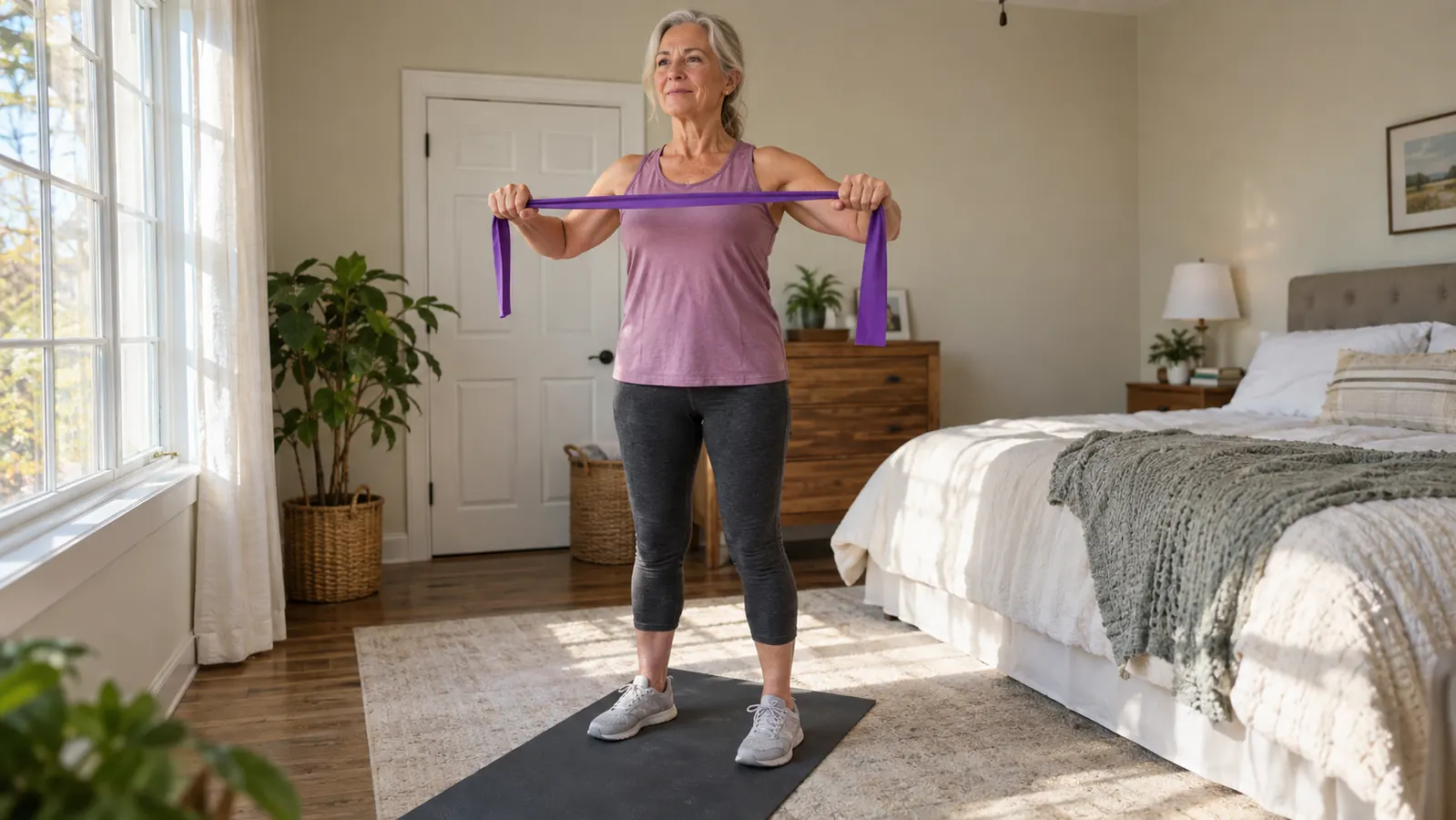
A year ago I bought the WHATAFIT resistance bands with handles, the 150 lb set, and I have used them three days a week ever since, except for one week in February when a cold kept me on the couch. I am 62. I live alone in Coeur d'Alene, Idaho, and my workout room is a spare bedroom that measures about 10 by 11 feet. There is a mat on the hardwood floor, a shelf for hand weights, and a closet where everything has to go back when I am done. I do not own a treadmill or a rack. I do not belong to a gym. I wanted something I could pull out of the closet, use for twenty minutes, and put away before the kettle finishes boiling.
My reasons for looking at bands were specific. My left knee complains on stairs and after long drives, and my right shoulder still remembers a fall I took in 2019. I walk three or four miles most mornings on the river trail, and I take a swing dance class on Thursday evenings, so I am not starting from zero. But I had reached the age where I could feel strength leaving my arms and legs, and I did not want to wait until a grocery bag felt heavy. I had tried a few things before this set, which I will get to later, and most of them disappointed me in one way or another. This one has held up. Here is what a year of daily use actually looks like.
The Quick Verdict
A sturdy, well-made set of five bands that has survived a year of three-day-a-week use in a spare bedroom. The handles are comfortable, the resistance is honest, and the whole thing stores in a drawer. It will not make you strong by itself, but it makes it easy to get strong at home, which at 62 is the whole point.
Amazon Check Today's Price →The set I keep pulling out of the closet three days a week
Five bands, comfortable handles, a door anchor, and a bag that fits in a drawer. A year in, nothing has snapped, stretched out, or fallen apart.
Amazon Check Today's Price on Amazon →How I've Used It
My routine is simple. Three days a week, usually Monday, Wednesday, and Friday after my walk, I spread the mat in the small room and work through about twenty minutes of exercises. I start with the lightest band for shoulder work, because my right shoulder needs to be warmed up before it does anything harder. I do rows, chest presses against the door anchor, bicep curls, and a set of what are called band pull-aparts, which is just holding the band at chest height and pulling it apart slowly. Then I switch to a heavier band for squats, standing on the middle of the band with both feet and holding the handles at my shoulders.
I keep a small notebook in the drawer of the bedside table, and I write down what I did and how it felt. That sounds fussy, but it is the only way I can tell whether I am actually making progress. In the first month I could do twelve squats with the middle band and my legs shook on the last three. By month three I could do twenty and the shaking was gone. In month five I moved up to the next band for the first time. Those are small numbers, but they are real numbers, and at my age small progress is still progress.
The door anchor gets the most use. It is a strap with a loop that goes over the top of a door and sits between the door and the frame, and you clip a band to it. I close the door on it, stand facing away, and do rows. It has never slipped, even when I have a heavy band loaded on it and I am pulling hard. I was worried about this at first, because I pictured the strap tearing or the door flexing, but after a year of use it is still snug. I do check it each time before I lean back, because that is the kind of caution that keeps a person out of the urgent care.
What's in the Set and How It Feels
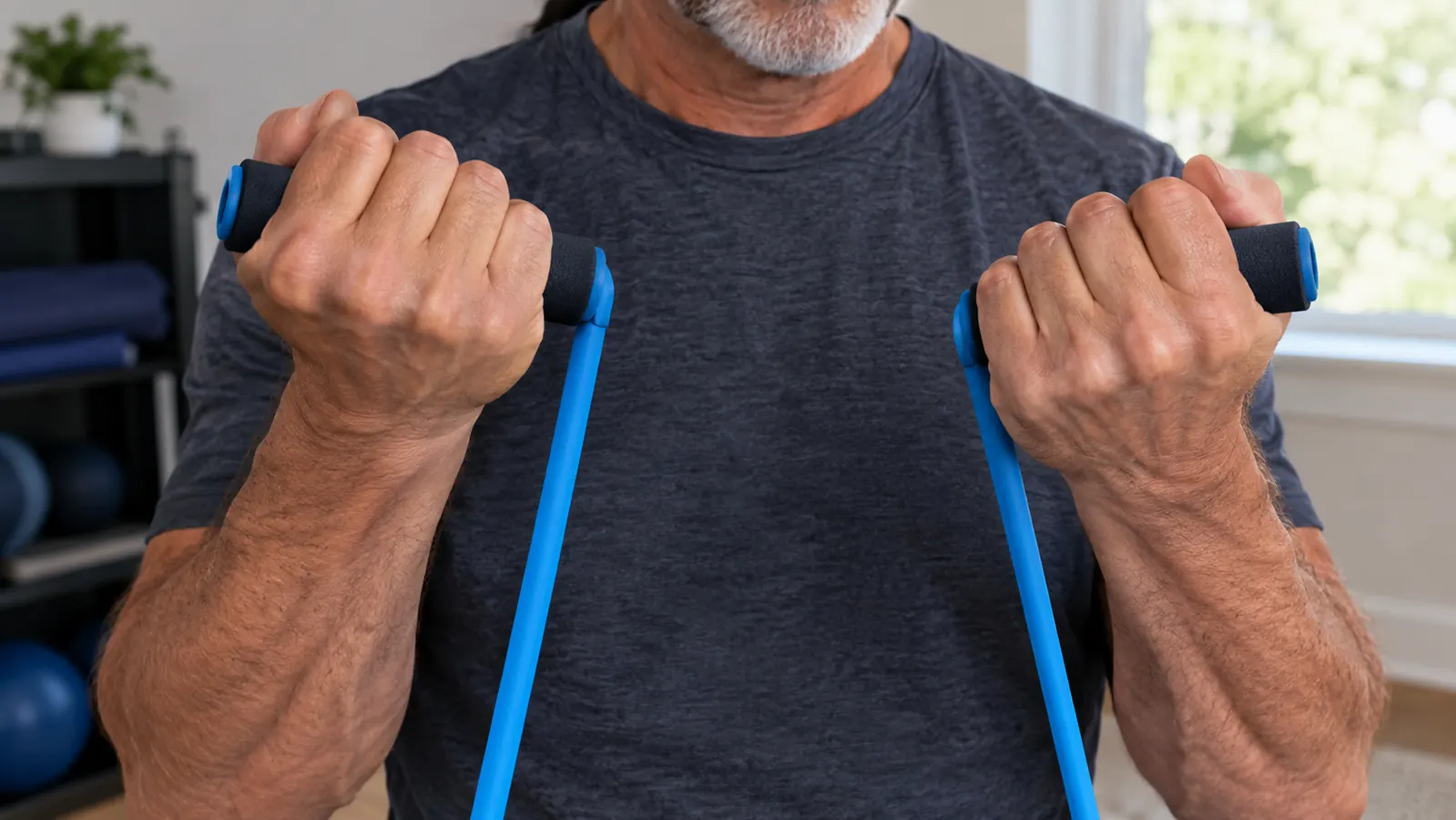
The set comes with five bands in different resistance levels, two foam handles, a door anchor, two ankle straps, and a cloth bag to keep it all in. The bands are long, flat tubes with metal clips at each end, and the clips attach to the handles, the ankle straps, or the door anchor. You can also use the bands on their own without handles, which is handy for a few exercises, though I almost always use the handles because they are easier on my hands.
The handles are the part I was most skeptical about, and the part that surprised me. I have used cheap bands before where the handles were thin plastic that dug into my palms. These have a thick foam grip that runs the full length of the handle, and they do not slide around even when my hands are a little damp. The clips snap on and off with one hand, which matters when you are switching bands between sets and you do not want to bend over thirty times. The bands themselves feel dense, not like the flimsy rubber tubes you find in bargain sets. They have a slight stretch to them, but they do not feel like they are going to tear.
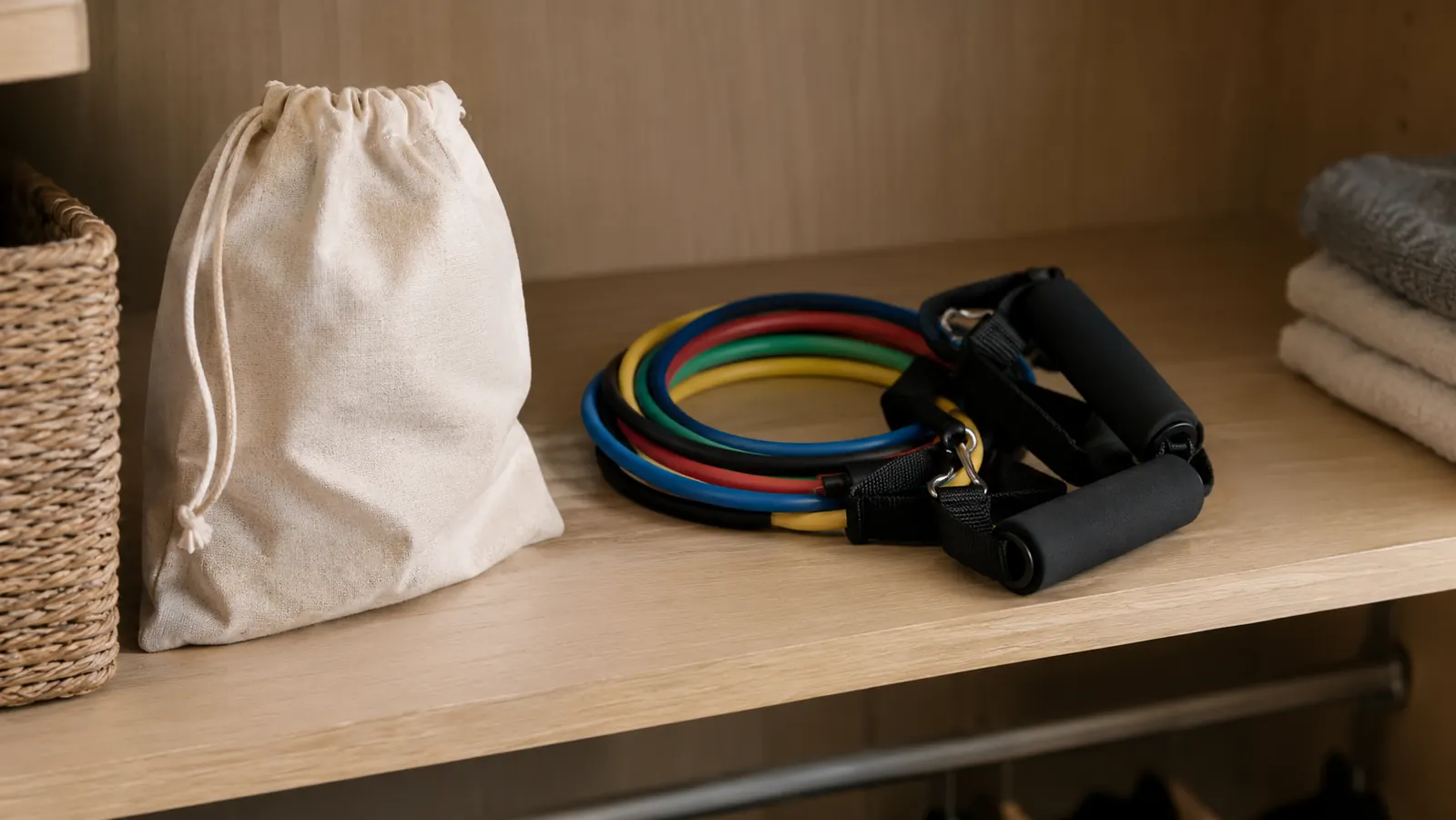
The bag is a small thing, but it matters in a house where everything has to live in a closet. The whole set rolls up and fits in the bag, and the bag fits in a drawer. When I finish a session I put the bands back in the bag, tuck it in the closet, and the small room goes back to being a spare bedroom. That sounds like a small point, but it is the difference between a piece of gear I actually use and one I leave on the floor because putting it away is a chore.
Strength Work That Respects an Aging Shoulder and Knee
The reason I chose bands over more weights was my shoulder. After the fall in 2019 I spent a long time being careful with it, and I worked out something that has stuck with me: the shoulder feels better when it moves through its full range, and a weight pulls straight down whatever the shoulder is doing. A band lets you control the tension through the whole movement, so you can make an exercise harder at the top and easier at the bottom, or the other way around, just by changing where you stand and how much band you take up.
For the knee, bands let me strengthen my legs without the impact of jumping or the strain of heavy squats with a bar. I do not jump. I do not run. I do slow, controlled squats and step-ups and side steps with a band around my thighs, and that has been enough to keep the knee feeling stable on stairs. I am not pretending this is a substitute for a trainer or for medical advice. It is not. But it is a way to do real strength work at home, on my own schedule, without loading a joint that has already told me it wants to be treated gently.
The tension is honest, which is another way of saying the bands do what they claim. Each band is marked with a resistance level in pounds, and while I cannot verify the exact numbers with a scale, the jump from one band to the next feels real. When I moved from the middle band to the heavier one, I felt it immediately in my legs. That is what I want from a piece of equipment: a clear, repeatable amount of work that I can gradually increase.
How It Holds Up Over a Year
I will be direct about this: I did not expect the WHATAFIT bands to still look this good. I have owned resistance bands before that developed cracks, stretched unevenly, or simply gave out after a few months. This set has been used three days a week for a year, roughly a hundred and fifty sessions, and I cannot see any cracking or fraying. The clips still snap tight, the handles still hold their shape, and the bands return to their original length when I put them away.
I take one precaution that I think has helped. I never leave the bands stretched out on the floor after a session, and I never hang them in the sun. They go back in the bag, in the closet, in the dark. I also check them before each use, running my fingers along the full length to feel for any rough spot or thin place. So far there has been nothing to find. I would not hesitate to buy another WHATAFIT set when this one eventually wears out, which at this rate will be a long time from now.
One honest note: the printed resistance numbers on the bands have faded a little from handling, and I have to squint to read the smaller ones. That is cosmetic, not functional. I know which band is which by feel now anyway, because I use the same ones every week. But if you are the kind of person who likes to grab a specific band without thinking, you might want to put a small piece of tape on each one with a marker.
What I'd Change, or Where It Gets Annoying
Nothing is perfect, and this set has three small annoyances worth mentioning. The first is the ankle straps. They work fine for leg exercises, but they are a little fiddly to get snug, and I find myself adjusting them between every set. If you are planning to do a lot of leg work with the bands around your ankles, expect to spend a few minutes getting comfortable with the straps.
The second annoyance is that the door anchor needs a door that closes fully. In my house that is fine, but if you have a door with a big gap or one that does not latch properly, the strap can be hard to seat. It has never slipped on me, but I can imagine it being a problem in an older house or an apartment with heavy doors. It is worth testing the anchor on the door you plan to use before you commit to a routine built around it.
The third thing is more about me than the product. Resistance bands do not give you the same clear feedback as a stack of weights. You cannot look at a number and know exactly how much you lifted. You have to pay attention to how the movement feels, count your reps honestly, and keep that notebook. For some people that is a feature, because it forces you to listen to your body. For me it took a few weeks to get used to.
Alternatives I Considered
Before I settled on this set I tried two other approaches. The first was a pair of light dumbbells, which I still use for a few things. They are fine, but they take up more room than I wanted, and for my shoulder they did not let me move through the full range comfortably. The second was a set of loop bands, which are the flat rings you see in a lot of online videos. Those are excellent for side steps and glute work, but I found them awkward for rows and presses, which are the exercises I need most.
I also looked at a resistance band set with a bar attachment, which would let me do movements that feel more like a gym. In the end I decided the bar would be too much to store and too much to set up in my small room. The WHATAFIT set does everything I actually need it to do, and it fits in a drawer. That tradeoff was the right one for me.
What I Liked
- Comfortable foam handles that do not dig into your palms
- Five bands offer a real range from light shoulder work to heavy leg work
- Door anchor is sturdy and has never slipped in a year
- Whole set stores in a small cloth bag that fits in a drawer
- Clips attach and detach easily with one hand
- Bands show no cracking or stretching after roughly seventy sessions
Where It Falls Short
- Ankle straps are fiddly to get snug and need adjusting between sets
- Door anchor needs a door that closes fully to seat properly
- Printed resistance numbers have faded a little with handling
- Bands do not give the same clear feedback as a stack of weights
A year in, nothing has snapped, stretched out, or fallen apart, and that is the whole review in one sentence.
Who This Is For
Buy this set if you are over 55, you want to do strength work at home, and you have a closet or a drawer to spare. It is ideal for someone who walks most days and wants to add resistance work without joining a gym or hiring a trainer. It is also a good fit if you have a joint that complains, like my knee or my shoulder, because bands let you control the tension through each movement instead of fighting a fixed weight.
It is for the person who will actually use it. That sounds obvious, but it is the real test. A set like this is only worth anything if it comes out of the closet three days a week. If you are the kind of person who likes to keep a notebook and track small progress, you will get a lot out of it. If you just want to pull a band out and do a few stretches, it will do that too, and it will do it without taking over your house.
Who Should Skip It
Skip it if you are looking for heavy progressive overload, the kind of thing a barbell gives you. Bands can get you strong, but they will not replace a gym for someone who is already lifting heavy weights and wants to keep pushing that number up. This is a home maintenance tool, not a competition program, and it is honest about that.
Skip it if you know you will not use it. I say that with kindness, because I have owned equipment I never touched. If the idea of setting up a mat and clipping bands to handles three times a week sounds like a chore you will avoid, then the money is better spent on a few sessions with a trainer or a class you actually enjoy. The band set is a tool for people who will pick it up, and there is no shame in knowing whether you are that person.
The set I still reach for three days a week
A year of use, no cracks, no slips, and it stores in a drawer. If you are over 55 and want to keep your strength at home, this is the set I would buy again.
Amazon Check Today's Price on Amazon →