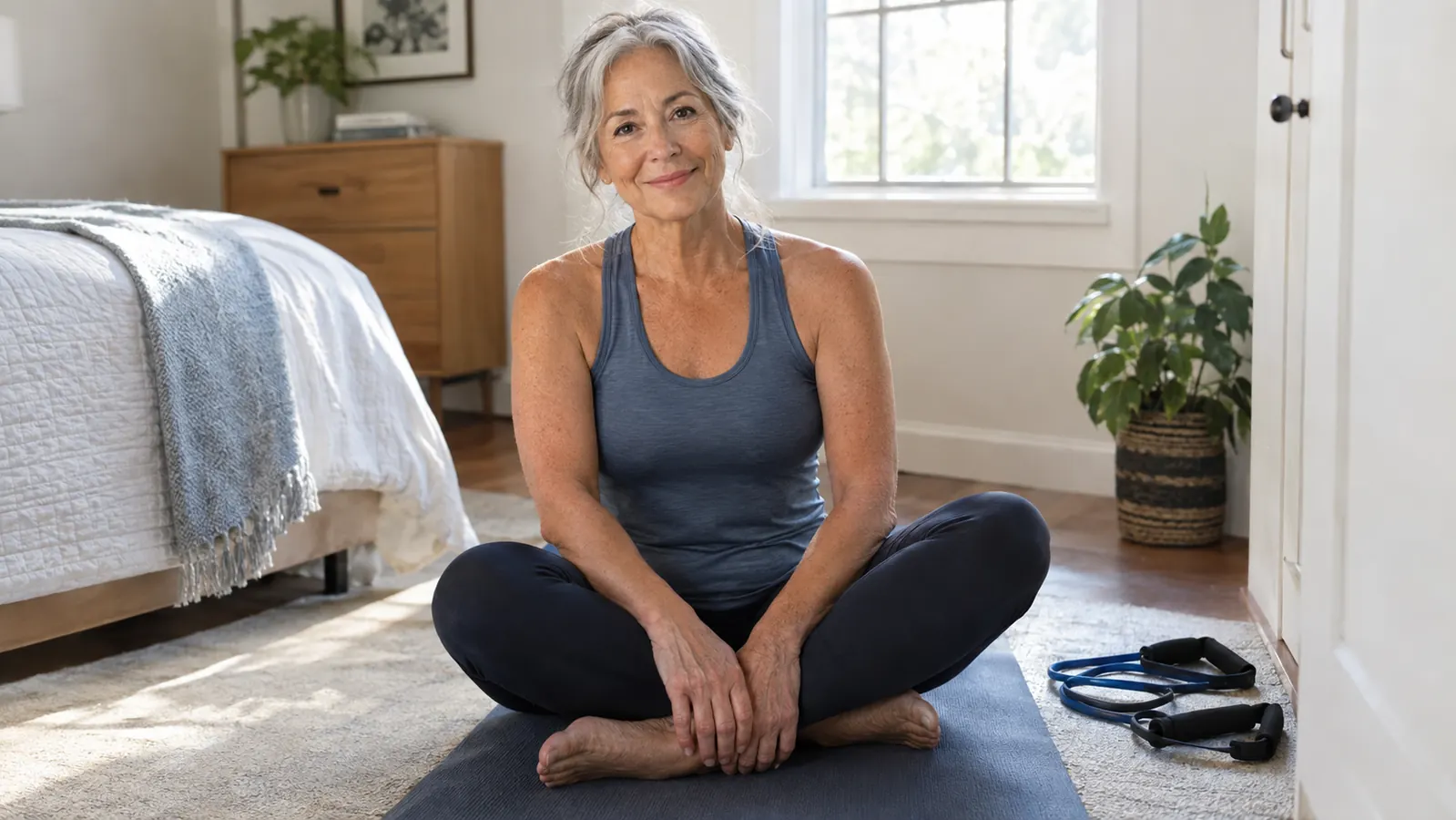
Three years ago, I could carry a full laundry basket up the stairs without thinking about it. Last winter I had to set it down halfway and rest. That was the moment I stopped telling myself I was fine for my age and started looking for a way to rebuild strength that didn't require a gym membership or a trainer. My spare bedroom, the one I call the small room, is roughly ten by eleven feet. There's a mat on the floor and a closet door that closes. That's the whole gym. A set of WHATAFIT resistance bands with handles has been sitting in that closet for a year now, and they've done more for my knee and my shoulder than anything else I've tried.
I'm not a personal trainer. I'm a retired school administrator who walks three or four miles most mornings on a river trail and takes a swing dance class on Thursday evenings. My left knee complains on stairs after long drives, and I rehabbed my right shoulder after a fall in 2019. So when I say these bands work, I mean they work for a body that has a few miles on it. Here's the exact plan I follow, step by step.
The exact set I use, three days a week
These are the bands that have been on my floor for a year. They anchor to a door, store in a drawer, and give me a full-body workout without leaving the room.
Amazon Check Today's Price on Amazon →This is not a complicated plan. It's the same five moves I do three times a week, and it's taken me from needing to rest on the stairs to carrying a full laundry basket again. The bands are the tool, but the plan is what does the work.
Step 1: Set up your space and your bands
The first thing I do is clear a small square of floor. I don't need a lot of room. I use a yoga mat I already owned, but a folded towel works too. The bands come with a door anchor, which is a little piece of fabric that loops over the top of a closed door and has a ring on the end. You hook the band through the ring, close the door, and you have a secure anchor point in seconds. I've used it on the bedroom door and the bathroom door without any damage.
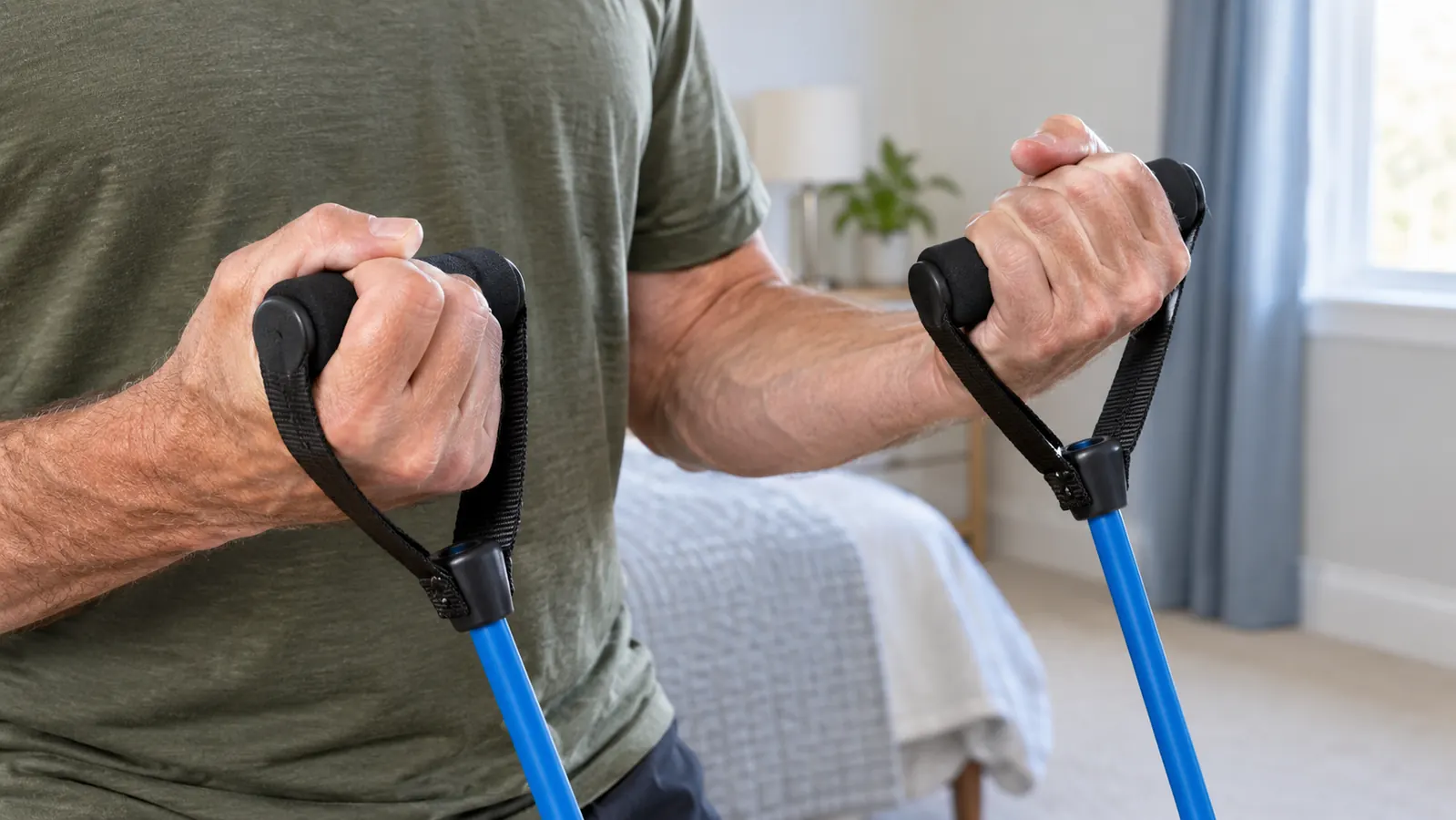
Before I started, I laid out all the bands that came in the WHATAFIT set. There are several tubes with handles, each with a different resistance level. I gave each one a quick test by pulling on it to feel the tension. That took about five minutes and it told me which band would be good for which exercise. I also made sure the handles felt comfortable in my hand. If a handle is too thin or too slick, you'll grip it too hard and your forearm will tire before the muscle you're trying to work.
I also learned to check the door anchor before every session. The little fabric piece can slip if the door isn't closed firmly. I give it a tug before I start, and I never anchor to a door that swings toward me because the band could pull it open. Once you have the anchor right, the rest is easy.
Step 2: Find the right tension for each move
The biggest mistake I see people make with bands is using the heaviest one for everything. That's how you hurt yourself. The right tension is the one that lets you complete the movement with good form while still feeling a real challenge in the last two reps. If you can't do eight slow reps without wobbling, the band is too heavy. If the band feels slack at the start of the movement, it's too light.
For upper body work like rows and chest presses, I start with the lightest band. For lower body moves like squats and hip hinges, I use a heavier one because my legs are stronger than my arms. The WHATAFIT set has a range of resistances, so I can switch bands as I move through the routine. I keep a small towel nearby to wipe the handles if my hands get sweaty, and I never pull a band toward my face because that's how you get a spring-loaded handle in the eye.
One trick I use is to hold the band closer to the anchor to increase tension without switching to a heavier band. If a move feels too easy, I shorten the band by gripping it further down the tube. That way I can fine tune the resistance in small steps, which is gentler on my joints than jumping to the next band.
Step 3: Warm up before you start
I don't stretch first. I move first. I do five minutes of marching in place, shoulder circles, arm crosses, and leg swings. This gets blood moving into the joints and wakes up the stabilizer muscles. For my shoulder, I do ten slow arm circles each direction with my hands on my hips. For my knee, I do ten gentle knee bends while holding the back of a chair. By the time I pick up the band, my body feels loose and ready.
The warm up is not optional. At 62, I've learned that a cold muscle is a pulled muscle. I also use the warm up to check in with my body. If my knee is complaining that day, I'll back off the squat and do more hip hinges. If my shoulder feels tight, I'll skip the chest press and do more rows. The bands are forgiving because you control the resistance, but they don't forgive a rushed start.
I also pay attention to my breathing. I exhale on the effort and inhale on the release. It sounds small, but holding my breath made me dizzy at first. Slow, steady breathing keeps the blood pressure in check and helps me stay calm through the harder reps.
Step 4: The five exercises that cover your whole body
I rotate through five moves that hit the major muscle groups. The first is a standing row. I loop the band around the door anchor at chest height, hold a handle in each hand, and pull my elbows back as I squeeze my shoulder blades. I do three sets of twelve. The second is a squat. I stand on the middle of the band with my feet shoulder width apart, hold the handles at my shoulders, and sit back like I'm reaching for a chair. Three sets of ten.
The third is a chest press. I anchor the band behind me at shoulder height, face away from the door, and push both handles forward until my arms are straight. Three sets of ten. The fourth is a hip hinge, which is the move that has helped my lower back the most. I stand on the band, hinge at my hips, and pull the handles toward my thighs while keeping my back flat. The fifth is a bicep curl, the one move that makes my arms feel strong when I carry groceries. I stand on the band, keep my elbows at my sides, and curl the handles up to my shoulders.
I do these five exercises in a circuit, resting about a minute between moves. The whole routine takes me about twenty-five minutes. I don't rush it. I use a slow, controlled tempo on both the pull and the release. That's where the strength comes from, not from speed. Form matters more than the number on the band. For the row, I keep my shoulders down and away from my ears. For the squat, I keep my knees tracking over my toes and my chest up. For the chest press, I don't lock my elbows at the top. I move through a full range of motion without forcing it.
Step 5: Make it a habit and progress slowly
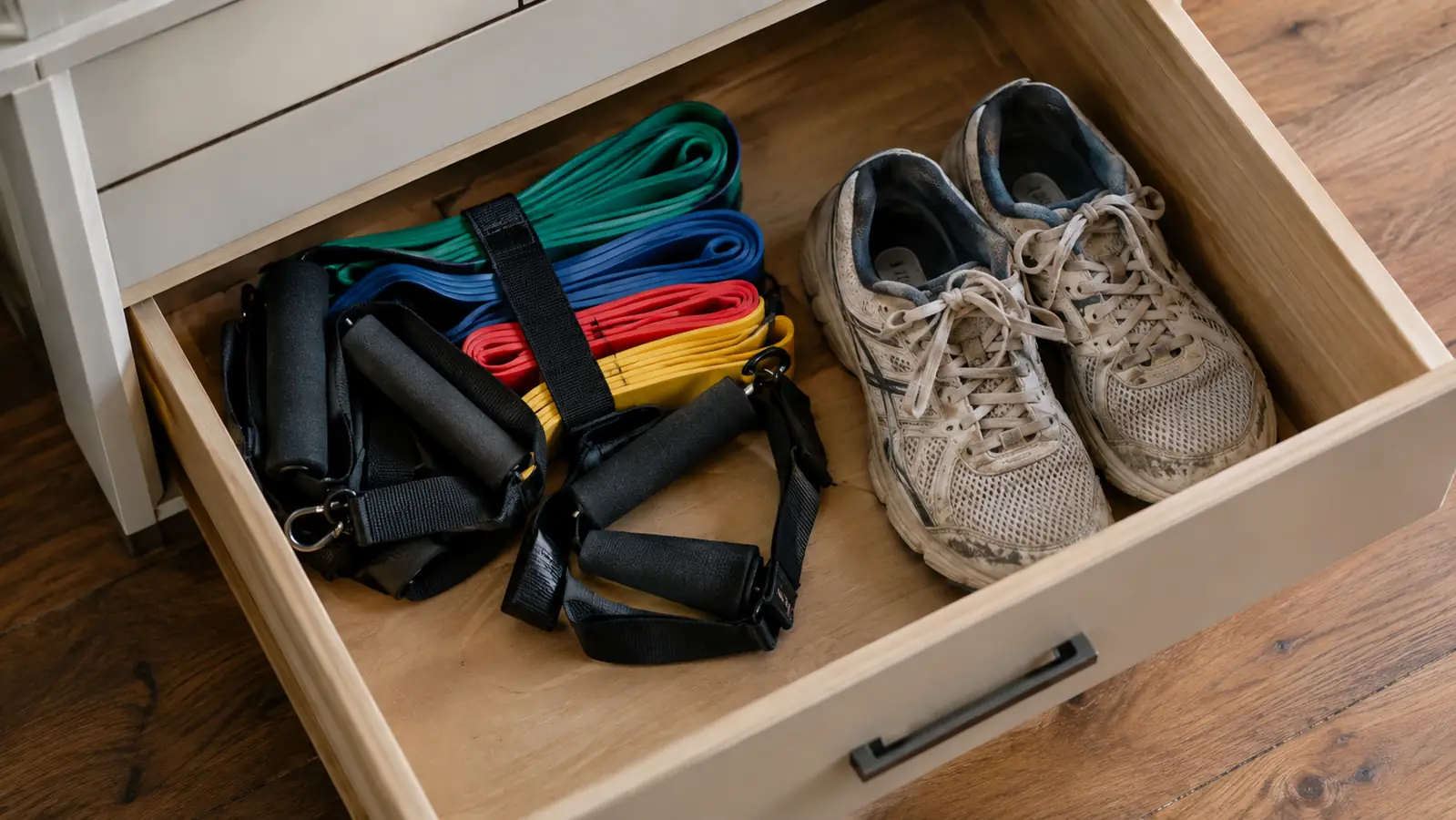
I do this routine three days a week, usually Monday, Wednesday, and Friday. I schedule it in the morning before I do anything else, because if I wait until evening, the day has a way of filling up. I keep the bands in a cloth bag in the closet, and I lay them out on the mat the night before. That small ritual means I don't have to decide whether to exercise, I just do it.
I track my progress in a simple notebook. I write down which band I used for each exercise and how many reps I completed. When I can finish three sets of twelve with good form on the heaviest band that still feels challenging, I move up to the next band for that move. It took me six weeks to move up on my lower body moves and ten weeks on my upper body. That's fine. Slow progress is still progress, and it's progress that lasts.
There are weeks when I miss a day. Life happens. I don't beat myself up. I just pick up where I left off. The bands are forgiving because they don't have a memory. The strength you build stays with you, and it comes back faster than you think.
The best exercise is the one you actually do, and the bands make it easy enough to do it three days a week.
What Changed for Me
A year ago, I couldn't do a single push up. I'm not saying I can do one now, but my arms are stronger and my shoulders feel stable. The biggest change is in my knee. The stairs in my house used to be a source of dread. Now I take them two at a time without thinking, and I don't grab the railing unless I'm carrying something heavy.
The other change is mental. Knowing I can handle a heavy grocery bag or lift a full canning pot gives me a sense of independence that no pill can provide. My sister noticed the difference when I visited her in Spokane. She asked what I was doing, and when I told her about the bands, she said, 'Keep doing that.' That's the kind of feedback that keeps me going.
I also notice my balance has improved. I used to hold the counter when I put on pants. Now I can stand on one leg while I pull on a sock. It's not a party trick, but it's a sign that the stabilizer muscles are waking up.
What Else Helps
Beyond the bands, I've found three things that make a difference. The first is walking. I still get out on the river trail most mornings because strength work and walking support each other. The second is consistency. I don't aim for perfect workouts, I aim for showing up. The third is listening to my body. If something hurts, I stop. I'm not training for a competition, I'm training to keep carrying my own groceries and to keep dancing on Thursday nights. The WHATAFIT bands are a tool, not a magic answer. The magic is in the doing.
One more thing: I also use the bands on days when I'm traveling. They pack flat and I can do a quick session in a hotel room. That keeps the habit alive even when I'm away from home.
If you're over 55 and you've been putting off strength training because you don't want to join a gym or because you're not sure where to start, this is your sign. The bands are inexpensive, they store away, and they meet you where you are. Start with one move. Do it twice a week. Build from there. Your future self will thank you.
Ready to start? This is the set I keep reaching for
The WHATAFIT resistance bands with handles have held up through a year of regular use. They store in a drawer, they anchor to any door, and they're built to last.
Amazon Check Today's Price on Amazon →